 0
0
 0
0
Anand, Gujarat
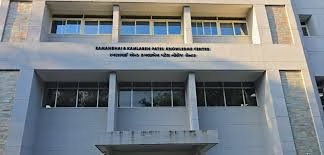
In a landmark development for Indian medical education, the country’s first dedicated Bioethics Centre was officially launched this week at Pramukhswami Medical College (PSMC) in Anand, Gujarat. Established under the auspices of the International Chair in Bioethics (ICB), based at the University of Porto, Portugal, the centre marks a pivotal shift toward institutionalizing ethical training in India’s healthcare landscape.
The launch, held at the Bhaikaka University campus in Karamsad—the hometown of Sardar Vallabhbhai Patel—comes at a critical juncture when the Indian healthcare system is grappling with a widening trust deficit between doctors and patients. The centre aims to systematically train doctors, nurses, and medical students in the principles of bioethics, moving beyond the traditional focus on clinical skills to emphasize empathy, patient rights, and moral decision-making.
A Response to a Growing Crisis
For decades, medical education in India has been heavily skewed toward clinical competence—diagnosing diseases and prescribing treatments. However, the “soft skills” of medicine, such as breaking bad news, obtaining informed consent, and navigating complex moral dilemmas, were often left to be learned on the job.
“One of the biggest challenges faced by medical professionals today is ensuring that patients feel satisfied with their treatment and confident that their care is proceeding correctly,” said Dr. Dinesh Kumar, Additional Dean of Pramukhswami Medical College, during the launch. “It is often observed that doctors do not always adopt a sensitive approach towards patients and fail to gain their trust. We study the principles of medical ethics, and we provide that education to students and other doctors.”
The establishment of this centre acknowledges that clinical brilliance without ethical grounding can lead to patient dissatisfaction and, in severe cases, medical negligence litigation or violence against healthcare professionals.
From Classroom to Bedside: How It Works
Unlike traditional medical ethics modules, which are often relegated to forensic medicine textbooks, the new Bioethics Centre proposes a dynamic, integrated approach. It will serve as a hub for education, research, and policy advocacy.
Dr. Barna Ganguly, appointed as the Head of the Bioethics Centre, described the initiative as a paradigm shift. “This ‘Centre of Bioethics’ is a new concept,” she explained. “It is involved not just in theoretical teaching but in areas like medical education and research within the health sector.”
The centre’s mandate includes:
-
Curriculum Integration: Embedding ethical case studies into anatomy, physiology, and clinical rotations.
-
Faculty Development: Training senior doctors to serve as ethical role models.
-
Research: Conducting studies on the specific ethical challenges unique to the Indian context, such as resource allocation in rural healthcare.
The Student Perspective
For the students at PSMC, the change is already palpable. The curriculum moves beyond rote memorization of the Hippocratic Oath to practical applications.
“We have been taught about bioethics from the first year,” shared Janhvi Topiwala, a medical student at the college. “We are told what bioethics is and how we can incorporate it into our daily lives.”
This early exposure is designed to normalize ethical thinking. Instead of viewing ethics as a legal hurdles, students are taught to view it as a clinical tool that improves patient outcomes. For instance, understanding the ethics of autonomy helps a doctor better explain a treatment plan, leading to higher patient adherence.
Context: The Evolution of Bioethics in India
To understand the significance of this launch, one must look at the broader context of Indian medical education. For years, bioethics was a fragmented discipline. In 2019, the National Medical Commission (NMC) introduced the AETCOM (Attitude, Ethics, and Communication) module, making ethical training mandatory for the first time.
However, implementation has been uneven due to a lack of trained faculty and specialized resources. The launch of a dedicated centre at PSMC, backed by an international body like the ICB, provides a model for other institutions to follow. It bridges the gap between the NMC’s mandate and on-the-ground reality.
“Bioethics in India has historically been reactive—arising after a scandal or a lawsuit,” notes Dr. Ravi Shankar (name changed for illustrative context), a senior public health ethics researcher not involved in this project. “A proactive centre that focuses on training before errors occur is exactly what the system needs. It aligns with global standards where medicine is viewed as a social contract, not just a biological service.”
Global Standards, Local Application
The centre’s affiliation with the International Chair in Bioethics (formerly the UNESCO Chair in Bioethics) is significant. It connects Indian medical professionals with a global network of ethicists, allowing for the exchange of ideas on universal challenges like end-of-life care, genetic engineering, and AI in medicine.
However, the centre faces the challenge of adapting these global principles to local realities. In India, where family often overrides individual autonomy in medical decision-making, Western bioethical frameworks require careful cultural translation. The centre’s success will depend on its ability to navigate these cultural nuances while upholding universal human rights.
Implications for Public Health
For the average patient, the existence of such a centre holds the promise of a more humane healthcare experience. It signals a move toward “person-centered care,” where the patient is a partner in decision-making rather than a passive recipient.
As the centre begins its operations, its impact will likely be measured not just by the number of workshops held, but by the quality of doctors it produces—professionals who are as compassionate as they are competent.
Medical Disclaimer:
This article is for informational purposes only and should not be considered medical advice. Always consult with qualified healthcare professionals before making any health-related decisions or changes to your treatment plan. The information presented here is based on current research and expert opinions, which may evolve as new evidence emerges.
References
-
News Report: IANS. (2025, December 12). India’s first ‘Bioethics Centre’ launched at Pramukhswami Medical College in Anand. Morung Express/Social News XYZ.