 0
0
 0
0
VISAKHAPATNAM — In a significant stride toward inclusive education, a new assistive technology developed in Visakhapatnam promises to transform how visually impaired children acquire foundational literacy. The innovation, a sensor-based Braille Learning Assistant Embedded Kit (LAEK), is designed to address a critical bottleneck in special education: the acute shortage of trained instructors and the resulting lack of independent practice opportunities for blind students.
Developed by Mohammed Khwaja Muinuddin Chisti, an Assistant Professor in the Department of EECE at GITAM Deemed to be University, the device offers a solution to the “Braille literacy crisis” that affects millions of children in India. By enabling students to practice reading and writing without constant supervision, the kit aims to foster autonomy and confidence in learners who have historically relied entirely on one-on-one instruction.
The Innovation: How It Works
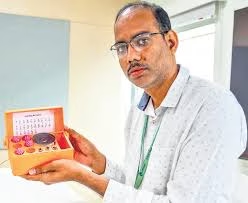
The LAEK device distinguishes itself from traditional learning tools through its interactive, multisensory design. At its core is a 3×2 hollow hemispherical Braille cell—replicating the standard six-dot configuration of the Braille script—embedded with sensitive electronic sensors.
When a student places a pattern of balls into the cell to form a letter or number, the sensors instantly detect the configuration. The system then decodes the tactile input and provides immediate audio feedback, announcing the corresponding character or instruction. This loop of action and feedback allows the child to verify their understanding in real-time.
“The device is designed to be intuitive,” Professor Chisti explained in a statement regarding the development. “It allows students to practice and revise lessons without waiting for a teacher to guide every step. Many students hesitate to ask the same doubt again; I wanted to create something that lets them learn comfortably at their own pace.”
Recognizing the logistical challenges of a classroom environment, the kit also features a ‘Help Me’ button. This function alerts the teacher only when a student encounters a persistent difficulty, allowing instructors to manage their time more effectively across a crowded classroom.
Addressing a Public Health and Educational Crisis
The introduction of such technology comes at a critical juncture for India’s public health and education sectors. India is home to approximately 15 million blind individuals, accounting for roughly one-third of the world’s blind population. Despite these numbers, Braille literacy rates remain alarmingly low—estimated by some advocacy groups to be as low as 1%.
Public health experts and ophthalmologists have long warned that this “literacy gap” has profound long-term health and socioeconomic implications. While audio technologies and screen readers have improved accessibility, medical professionals emphasize that they are not a substitute for Braille.
“Audio learning is passive, whereas Braille is active literacy,” explains Dr. Aruna Sharma, a specialist in vision rehabilitation (not involved in this specific project). “For a child to understand spelling, grammar, punctuation, and complex concepts like mathematics, tactile engagement is essential. Without Braille, we are essentially raising a generation that is ‘print illiterate,’ which severely limits their cognitive development and future employment prospects.”
The Teacher Shortage Challenge
A primary driver of low literacy rates is the scarcity of special educators. In many government and charitable schools for the blind, the student-to-teacher ratio can be as high as 30:1. Since traditional Braille instruction requires the teacher to physically check the student’s fingertips and the dots they produce, it is a labor-intensive process that leaves little room for independent study.
The LAEK addresses this specific pain point. By automating the feedback loop, the device effectively acts as a personal tutor. This is particularly vital for students from rural areas who may not have access to residential blind schools. Professor Chisti notes that parents, even those who do not know Braille themselves, can use the device to guide their children at home, as the audio feedback bridges the knowledge gap.
Broader Perspectives and Future Implications
The device, which is currently patent-pending, has received attention for its potential to democratize special education. However, experts in the field caution that technology must be part of a broader ecosystem of support.
Dosapati Chaitanya Sai Ratna Kumar, Regional Centre Manager for Vision Aid in Visakhapatnam, welcomed the innovation while highlighting the evolving needs of the community. “India is home to a third of the world’s blind people,” he noted, adding that while Braille is foundational, there is also a pressing need to integrate such tools with modern “smart” education systems. He advocated for further advancements, such as upgrading white canes with sensors, suggesting that the future of accessibility lies in an interconnected web of assistive devices.
The implications for public health are significant. Studies published in journals such as the International Journal of Research in Medical Sciences have shown that Braille literacy is strongly correlated with higher self-esteem, independence, and employment rates among adults with visual impairments. By intervening early with tools like LAEK, the healthcare and education sectors can potentially reduce the long-term burden of dependency.
Limitations and the Road Ahead
While promising, the LAEK faces challenges common to medical and educational hardware: scalability and distribution. Currently, the device is a prototype developed within a university setting. For it to have a public health impact, it must be mass-produced and distributed at a cost affordable to low-income schools and families.
Professor Chisti has expressed intentions to manufacture and distribute units using research grants and donor support. Future iterations of the device are planned to include computer vision and speech recognition, which would further enhance its utility by helping students identify objects and people in their environment.
As technology continues to bridge the gap between disability and ability, innovations like the Vizag Braille kit serve as a powerful reminder: independence is not just about mobility; it is about the fundamental right to read, write, and learn on one’s own terms.
Medical Disclaimer:
This article is for informational purposes only and should not be considered medical advice. Always consult with qualified healthcare professionals before making any health-related decisions or changes to your treatment plan. The information presented here is based on current research and expert opinions, which may evolve as new evidence emerges.
References:
-
Primary News Source: “New Braille learning kit from Vizag aims to help visually impaired children practise independently.” EdexLive, 30 Nov 2025.
-
Innovation Details: “GITAM professor develops kit to enhance Braille learning.” The Hindu, 25 Nov 2025.
-
Statistical Data: “Cross sectional analyses on the prevalence and usage of braille among blind children.” International Journal of Research in Medical Sciences, 2022.
-
Expert Commentary: Dosapati Chaitanya Sai Ratna Kumar, Regional Centre Manager, Vision Aid (Source: The Hindu interview).
-
Global Health Context: World Health Organization (WHO) data on global visual impairment and blindness.
Indian startup designs ‘the world’s first self-learning braille literacy device’
This video highlights a similar Indian innovation in self-learning Braille technology, providing broader context on how such devices function and their impact on literacy for the visually impaired.