 0
0
 0
0
NEW DELHI — In a move set to accelerate India’s transition from a global manufacturing hub to a powerhouse of pharmaceutical innovation, the Ministry of Chemicals and Fertilisers announced a landmark collaboration this weekend between academia and the private sector.
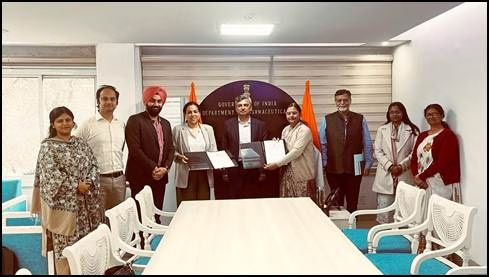
On February 21, 2026, the National Institute of Pharmaceutical Education and Research (NIPER), Raebareli, signed a Memorandum of Understanding (MoU) with Boehringer Ingelheim India. The agreement, formalized in the presence of Shri Manoj Joshi, Secretary of the Department of Pharmaceuticals, aims to modernize pharmaceutical education and research. Simultaneously, the government unveiled AMRITVA Cohort 2, a grant-backed initiative that will provide critical funding to five home-grown innovators to bring new medical technologies to market.
From “Volume” to “Value”: A Strategic Shift
For decades, India has been known as the “pharmacy of the world,” primarily due to its massive production of high-quality generic medicines. However, the Department of Pharmaceuticals is now steering the industry toward a “value-driven” model. This shift focuses on Novel Drug Delivery Systems (NDDS)—technologies that improve how medicine is absorbed by the body, reducing side effects and increasing patient compliance.
“Collaborative partnerships between academia and industry are critical for advancing domestic innovation,” stated Shri Manoj Joshi during the event. He emphasized that the goal is to ensure research does not stay trapped in a laboratory but instead reaches the public as “viable pharmaceutical products and entrepreneurial ventures.”
The Power of Open Science
A standout feature of the new MoU is the integration of Boehringer Ingelheim’s opnMe® platform. This open-science initiative provides Indian researchers with access to high-quality molecule compounds and biological tools that were previously proprietary.
By removing the “paywalls” and “patent-walls” of early-stage research, the platform allows NIPER scientists to test new hypotheses on well-characterized molecules, significantly shortening the time required for the initial stages of drug discovery.
AMRITVA: Feeding the Innovation Pipeline
The launch of AMRITVA Cohort 2 (Alliance for Medicinal Research, Innovation, Translation & Value Acceleration) marks a tangible investment in human capital. Implemented by the Startup Incubation and Innovation Centre (SIIC) at IIT Kanpur, the program bridges the gap between a brilliant idea and a commercial product.
Five innovators were selected for grant support under this Corporate Social Responsibility (CSR) backed program:
-
Three faculty-led projects: Focusing on high-level academic research with commercial potential.
-
Two research scholar-led projects: Empowering the next generation of scientists to lead their own startups.
“The journey from a bench-side discovery to a bedside treatment is fraught with financial ‘valleys of death,'” says Dr. Ashutosh Agnihotri, CEO of SIIC, IIT Kanpur. “Programs like AMRITVA provide the financial and mentorship oxygen needed to keep these innovations alive.”
Why This Matters for Public Health
For the average consumer, these high-level agreements translate into two major long-term benefits: affordability and efficacy.
-
Lower Costs: By developing indigenous technologies and drug delivery systems, India can reduce its reliance on expensive imported intellectual property, potentially lowering the cost of advanced treatments for chronic diseases like diabetes and cardiovascular conditions.
-
Better Treatments: Research into Novel Drug Delivery Systems (NDDS) means medicines can be designed to target specific organs or release slowly over time. This can mean the difference between taking a pill three times a day versus once a week.
Expert Insight: “When industry and academia speak the same language, the patient wins,” says Dr. Aranya Sen, a pharmaceutical consultant not involved in the MoU. “NIPER provides the raw intellectual talent, and companies like Boehringer Ingelheim provide the market discipline and resources. This is how you solve real-world health challenges.”
Challenges and Limitations
While the MoU is a significant step, experts caution that the road to pharmaceutical sovereignty is long. Developing a single new drug can take 10–12 years and cost billions of dollars.
Critics of such partnerships often point out that CSR-funded initiatives, while helpful, are smaller in scale compared to the massive R&D budgets of global pharmaceutical giants. Furthermore, translating research into “entrepreneurial ventures” requires a robust legal framework for intellectual property rights that protects both the innovator and the public interest.
Looking Ahead: Viksit Bharat 2047
These initiatives are pillars of the broader Viksit Bharat 2047 vision, which aims to transform India into a developed nation by its 100th year of independence. By fostering an ecosystem where a PhD student at NIPER can see their research become a startup, India is betting on its “brain power” to lead the next era of global healthcare.
As the five selected innovators from AMRITVA Cohort 2 begin their work, the eyes of the medical community will be on the results. If successful, this model of “Public-Private-Academic” partnership could become the blueprint for all future scientific endeavors in the country.
Reference Section
Primary Source:
-
Press Information Bureau (PIB) Delhi. “For Strengthening India’s Pharmaceutical Ecosystem, NIPER-Boehringer MoU for Education and Research & AMRITVA Cohort 2 Unveiled.” Posted 21 Feb 2026.
Medical Disclaimer: This article is for informational purposes only and should not be considered medical advice. Always consult with qualified healthcare professionals before making any health-related decisions or changes to your treatment plan. The information presented here is based on current research and expert opinions, which may evolve as new evidence emerges.