 0
0
 0
0
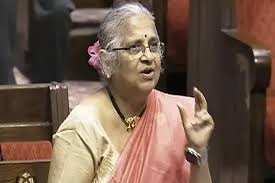
RAICHUR, KARNATAKA — In a move that has reignited a decades-old debate over regional healthcare equity, nominated Rajya Sabha member and renowned philanthropist Sudha Murty formally called upon the Union Government this week to establish an All India Institute of Medical Sciences (AIIMS) in Raichur. Speaking during Zero Hour in Parliament, Murty highlighted a stark geographic disparity: Karnataka remains the only South Indian state without an operational AIIMS, and the Kalyan Karnataka region—specifically Raichur—continues to grapple with a systemic lack of tertiary medical care that forces millions to seek treatment across state lines.
Why Raichur? The Anatomy of an “Aspirational District”
The choice of Raichur is not merely a matter of political preference but a response to acute developmental necessity. Raichur is currently classified by NITI Aayog under the Aspirational Districts Programme, a federal initiative targeting India’s most socio-economically challenged regions.
While the district has shown marginal improvements in basic health indicators, it remains a “healthcare desert” in terms of advanced medical infrastructure. According to NITI Aayog’s 2024 performance metrics, Raichur continues to lag in critical social-development sectors, including infrastructure and financial inclusion.
“The north of Karnataka, including Raichur and Yadgir, has historically seen significantly less investment compared to the south,” Murty noted during her address. This “North-South divide” traces back to the pre-independence era, where the southern regions benefited from the progressive administration of the Mysore Wadiyars, while the north remained largely marginalized.
The Cost of Distance: A Crisis for the Poor
For a resident of Raichur suffering from a complex cardiac condition or requiring oncology services, the current options are grim. Most patients must travel over 400 kilometers to either Bengaluru or Hyderabad.
This distance creates more than just a logistical hurdle; it creates a financial catastrophe for low-income families. Costs associated with:
-
Emergency ambulance transport
-
Loss of daily wages for family members
-
Private diagnostic fees in urban hubs
-
Short-term housing for caregivers
These expenses often exceed the actual cost of medical treatment, pushing vulnerable families deeper into debt. “When a family has to choose between a life-saving surgery and their ancestral land, the system has failed them,” says Dr. Ravi S. Hegde, a public health specialist familiar with the region’s landscape.
Education and Literacy: The Hidden Barriers
The healthcare crisis in Raichur is inextricably linked to human capital. Literacy data cited in Parliament paints a sobering picture: female literacy in the district stands at approximately 48%, while male literacy hovers around 60%.
In public health terms, low literacy is a direct predictor of poor health outcomes. It hinders “health-seeking behavior”—the ability of an individual to recognize symptoms early and navigate government schemes like the Ayushman Bharat program. An AIIMS-level institution acts not just as a hospital, but as a lighthouse for health literacy, providing community outreach and preventive education that can bridge these gaps.
The “AIIMS Effect”: More Than Just Hospital Beds
The establishment of an AIIMS in Raichur would theoretically serve an estimated 15 to 20 million people across North Karnataka and neighboring districts in Telangana and Maharashtra. Beyond the clinical impact, the “AIIMS Effect” refers to the socioeconomic transformation of a region:
-
Brain Gain: Premier institutes attract top-tier specialists, researchers, and medical students who otherwise migrate to metros or abroad.
-
Economic Hub: Large medical complexes generate thousands of indirect jobs in logistics, hospitality, and paramedical services.
-
Research Focus: An AIIMS in this belt could focus on regional health issues, such as fluorosis or specific maternal nutrition challenges prevalent in the drylands of the Deccan.
Navigating the Challenges: Expert Perspectives
Despite the enthusiasm, health policy experts urge a balanced approach. Building a “temple of modern medicine” is not an overnight fix.
“Equity-oriented expansion of tertiary care is essential,” explains Dr. Hegde, “but it must be planned alongside a parallel push to strengthen Primary Health Centres (PHCs). An AIIMS should not be a glorified primary care clinic because the local system has collapsed.”
Potential Bottlenecks Include:
-
Faculty Recruitment: Historically, new AIIMS locations in rural areas have struggled to fill senior faculty positions, as specialists often prefer urban lifestyle amenities.
-
Infrastructure Delays: Under the Pradhan Mantri Swasthya Suraksha Yojana (PMSSY), several new AIIMS projects have seen timelines stretched by years due to land acquisition and funding disputes.
-
The “Top-Down” Trap: Critics argue that focusing solely on a flagship hospital might neglect the urgent need for better rural transport and community health workers (ASHAs) who manage health at the doorstep.
The Road Ahead
The Karnataka state government has already signaled its readiness, offering land and existing administrative support in Raichur. Proponents argue that the district’s existing government medical college could serve as a “feeder” base, streamlining the transition to an AIIMS-tier facility.
For the families of North Karnataka, the demand represents a hope for a future where high-quality healthcare is a right of residency, not a privilege of geography. As the Union Ministry of Health evaluates the proposal, the focus remains on whether the government will correct the “anomalous” absence of an AIIMS in one of India’s most economically significant yet healthcare-strained states.
Medical Disclaimer
Medical Disclaimer: This article is for informational purposes only and should not be considered medical advice. Always consult with qualified healthcare professionals before making any health-related decisions or changes to your treatment plan. The information presented here is based on current research and expert opinions, which may evolve as new evidence emerges.
References
-
Medical Dialogues. “Sudha Murty urges Centre to set up AIIMS in Karnataka’s Raichur district.” (March 18, 2026).