 0
0
 0
0
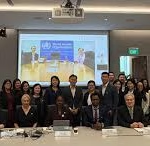
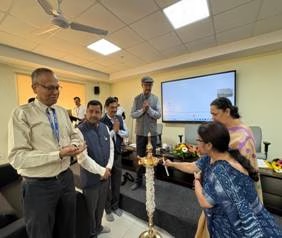
BELAGAVI, INDIA — In a significant move toward integrating ancient wisdom with modern evidence-based science, the CSIR-National Institute of Science Communication and Policy Research (NIScPR), in collaboration with the ICMR-National Institute of Traditional Medicine (NITM), hosted a landmark National Capacity Building Workshop on March 6, 2026.
The event, titled “Traditional medicine: Documentation, validation and Communication,” brought together over 60 researchers and medical professionals from 10 regional institutions. Held under the national initiative SVASTIK (Scientifically Validated Societal Traditional Knowledge), the workshop aimed to address a critical challenge in global health: how to rigorously verify traditional healing practices and communicate them effectively to a skeptical, science-oriented public.
The Science of Heritage: Moving Beyond Anecdotes
For centuries, systems like Ayurveda, Unani, and Sowa Rigpa have formed the backbone of healthcare for millions. However, the lack of standardized documentation and clinical validation has often relegated these practices to the periphery of “alternative” medicine.
Dr. Padma Gurmet, a Padma Shri recipient and Director of the National Institute of Sowa Rigpa (NISR), emphasized that traditional systems are not static relics of the past but living sciences. Speaking at the inaugural session, Dr. Gurmet highlighted the interconnectedness of Sowa Rigpa and Ayurveda, arguing that for these systems to achieve global visibility, they must undergo a rigorous process of documentation and validation.
“Traditional medicine requires a seat at the contemporary table,” Dr. Gurmet stated. “But that seat is earned through the translation of traditional knowledge into the language of modern science.”
The Role of SVASTIK in Public Health
The workshop served as a showcase for the SVASTIK initiative, a project designed to protect and perpetuate India’s traditional knowledge while filtering out misinformation.
Dr. Charu Lata, Principal Scientist at CSIR-NIScPR, outlined a systematic pipeline for traditional knowledge:
-
Identification: Locating local health traditions and indigenous practices.
-
Validation: Using scientific methods to verify the safety and efficacy of these practices.
-
Communication: Translating verified data into accessible content for the public.
The importance of this process cannot be overstated. According to the World Health Organization (WHO), approximately 80% of the world’s population uses traditional medicine. In India, where traditional practices are deeply embedded in the culture, providing “scientifically validated” information helps prevent the use of harmful or fraudulent “cures” while promoting genuine, cost-effective health interventions.
Global Perspectives and Regulatory Frameworks
Vaidya Pawankumar Ramesh Godatwar, representing the WHO Centre in New Delhi, provided a global lens on the workshop’s goals. He noted that the WHO has prioritized research in traditional medicine as a pathway to achieving affordable and sustainable universal health coverage.
However, integration is not without hurdles. Prof. Pulok Mukherjee, a leading expert in ethnopharmacology, urged researchers to focus on “sustainable bioresources.” He cautioned that the development of traditional products must strictly adhere to regulatory guidelines and ethical considerations.
“We must value local health traditions, but we must also protect the biodiversity that provides these medicines,” Prof. Mukherjee noted. This dual focus on efficacy and sustainability is essential for the long-term viability of herbal-based treatments.
From the Lab to the Smartphone: The Art of Science Communication
A unique feature of the Belagavi workshop was its focus on Science Communication. Dr. Subarna Roy, Director of ICMR-NITM, remarked that researchers, regardless of their career stage, must be equipped to talk to the public.
In an era of “infodemics”—where health misinformation spreads rapidly online—the ability of scientists to create engaging, accurate content is a public health necessity. Dr. Paramananda Barman, Senior Scientist at CSIR-NIScPR, led a hands-on session teaching participants how to:
-
Write popular science articles for the general public.
-
Design infographics that simplify complex biochemical pathways.
-
Create short, factual videos to combat “fake news” on social media.
“It is not enough to find a cure in a lab,” Dr. Barman explained. “If the public does not understand it, or if they are misled by unverified claims online, the science has failed in its societal duty.”
Challenges and Limitations
While the workshop represents a leap forward, the integration of traditional and modern medicine faces significant criticism. Some members of the conventional medical community argue that “traditional” knowledge often lacks the double-blind, placebo-controlled trials that are the gold standard of modern pharmacology.
Furthermore, there is the risk of “biopiracy,” where traditional knowledge is commercialized without benefiting the indigenous communities that preserved it. The SVASTIK initiative seeks to mitigate this by documenting knowledge in a way that establishes intellectual priority for the community while allowing for scientific growth.
What This Means for You
For the average consumer, the push for validation means more reliable choices. As these initiatives grow, patients can expect:
-
Verified Information: Clearer labels and better-vetted online resources regarding herbal supplements.
-
Integrated Care: Doctors who are better informed about how traditional treatments might interact with conventional prescriptions.
-
Safety First: A reduction in the promotion of “miracle cures” that have no scientific backing.
Prof. Ranjana Aggarwal, Former Director of CSIR-NIScPR, concluded her keynote by citing the concept of Panchkosha (the five layers of human existence), suggesting that the convergence of traditional holistic views and modern molecular science could lead to a more comprehensive era of human wellness.
References and Sources
Medical Disclaimer: This article is for informational purposes only and should not be considered medical advice. Always consult with qualified healthcare professionals before making any health-related decisions or changes to your treatment plan. The information presented here is based on current research and expert opinions, which may evolve as new evidence emerges.