 0
0
 0
0
NAGPUR — In a decisive move to fortify national health security against future pandemics, India’s leading scientific and medical authorities gathered this week in Nagpur to transition the “One Health” concept from a theoretical framework into a localized, actionable reality.
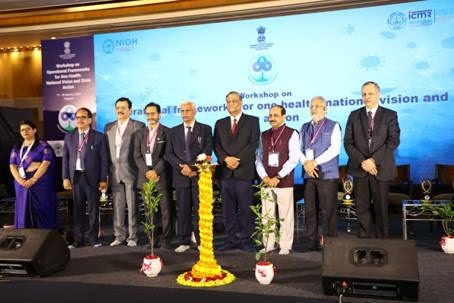
The two-day national workshop, titled “Operational Frameworks for One Health: National Vision and State Action,” concluded on March 19, 2026. Hosted by the National Institute of One Health (NIOH) under the Department of Health Research (DHR), the summit brought together a “who’s who” of Indian science and policy to address the increasing threat of zoonotic diseases—illnesses that jump from animals to humans—which now account for approximately 75% of emerging infectious diseases globally.
A Unified Front Against Viral Threats
The workshop served as a critical milestone for the National One Health Mission (NOHM), a “whole-of-government” initiative designed to break down the silos between human medicine, veterinary science, and environmental monitoring.
Delivering the keynote address, Prof. Ajay Sood, Principal Scientific Advisor (PSA) to the Government of India, characterized the mission as the bedrock of the nation’s safety.
“One Health is not just a concept, but the foundation of our national health security and future pandemic preparedness,” Prof. Sood stated. “Human health surveillance, veterinary disease reporting, wildlife monitoring, and environmental intelligence must move beyond parallel systems and become interoperable.”
The urgency of this integration cannot be overstated. With India’s dense population and close proximity between livestock, wildlife, and humans, the “spillover” risk—where a virus evolves to infect a new species—is a constant shadow. By creating a seamless data flow across departments, officials hope to identify “Patient Zero” in an animal population before a human outbreak even begins.
From National Vision to State Action
While the vision is set at the federal level, the workshop’s primary focus was “operationalization”—the “how-to” of implementing these complex strategies at the state and district levels.
Dr. Rajiv Bahl, Secretary of the DHR and Director General of the Indian Council of Medical Research (ICMR), emphasized that national security now depends on the coordination of local scientific institutions and government departments.
“The National One Health Mission exemplifies a whole-of-government approach in tackling zoonotic threats and strengthening medical countermeasures,” Dr. Bahl remarked during his virtual address. He specifically called for the establishment of state and district-level outbreak response teams that can act as the first line of defense during a biological crisis.
Key Focus Areas of the Workshop:
-
Integrated Surveillance: Merging data from hospitals, poultry farms, and forest reserves into a single early-warning system.
-
Biothreat Preparedness: Developing protocols for rapid identification of intentional or accidental biological hazards.
-
Medical Countermeasures: Accelerating the development of vaccines and treatments that can be adapted for multiple related pathogens.
-
Wildlife Investigations: Creating specialized teams to monitor disease patterns in India’s diverse ecological zones.
Why “One Health” Matters to the Average Citizen
For the general public, “One Health” might sound like high-level bureaucracy, but its implications for daily life are profound. It is the difference between a localized animal flu and a multi-year global lockdown.
“When we talk about One Health, we are talking about food safety, clean water, and the prevention of the next COVID-19 or Nipah virus outbreak,” says Dr. Prashant P. Joshi, Executive Director of AIIMS Nagpur and a guest of honor at the event. “For the consumer, this means more rigorous monitoring of the meat and dairy supply chain and faster public health alerts when a risk is detected in the environment.”
Experts at the workshop noted that environmental factors, such as deforestation and climate change, are driving animals closer to human settlements. This “interface” is where the next pandemic is likely currently brewing. By monitoring “sentinel” species—animals that show signs of illness before humans do—public health officials can intervene weeks or months earlier than current systems allow.
Challenges and Limitations
Despite the optimistic tone of the summit, significant hurdles remain. Integrating data across different ministries (Health, Agriculture, and Environment) is a monumental task. Historically, these departments have operated with different budgets, priorities, and data-sharing technologies.
Furthermore, critics and independent experts point out that “One Health” requires massive infrastructure investment at the rural level. While Nagpur may serve as a model for implementation, replicating this in remote districts with limited laboratory capacity remains a significant challenge.
“The strategy is world-class,” noted one attending researcher who requested anonymity, “but the success hinges on whether a village veterinarian in a remote district has the tools and the digital platform to report an unusual cattle death as easily as a doctor in New Delhi reports a fever.”
Looking Ahead: Maharashtra as a Model
Prof. Sood highlighted that Maharashtra is positioned to become the national blueprint for this structured implementation. With the National Institute of One Health (NIOH) headquartered in Nagpur, the state will lead pilot programs in inter-sectoral coordination that will eventually be scaled across India.
As the workshop concluded, the message was clear: the era of treating human health in isolation is over. The “National Vision” has been cast; the “State Action” is now underway.
Medical Disclaimer
This article is for informational purposes only and should not be considered medical advice. Always consult with qualified healthcare professionals before making any health-related decisions or changes to your treatment plan. The information presented here is based on current research and expert opinions, which may evolve as new evidence emerges.
References and Sources
-
Press Information Bureau (PIB) Delhi. “National Workshop on One Health organised in Nagpur.” Posted 18 March 2026.