 0
0
 0
0
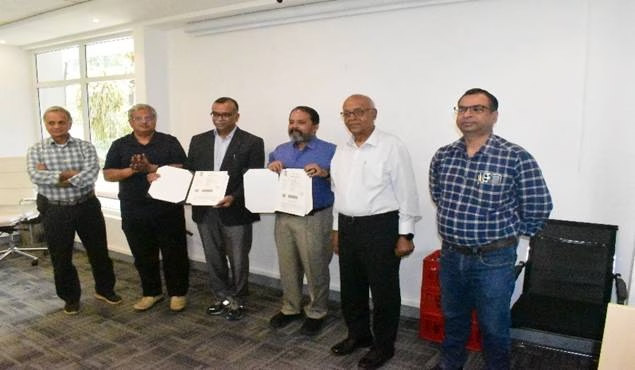
BENGALURU — In a move designed to accelerate the transition of laboratory discoveries into real-world medical treatments, the Jawaharlal Nehru Centre for Advanced Scientific Research (JNCASR) and YRGCARE signed a landmark Memorandum of Understanding (MoU) on March 13, 2026. This strategic alliance between one of India’s premier multidisciplinary research institutes and a leading clinical foundation aims to create a streamlined pipeline for tackling infectious diseases. By establishing a dedicated research laboratory and a distinguished faculty fellowship, the partnership seeks to address the “valley of death”—the notorious gap where promising basic science often stalls before reaching clinical application—to improve public health outcomes across India.
From Theory to Therapy: Strengthening the Research Ecosystem
The primary objective of this collaboration is to foster “translational research.” While basic research focuses on understanding the fundamental mechanisms of how a virus or bacteria functions, clinical research focuses on how to treat the patient. Historically, these two worlds have operated in silos.
The new agreement brings together the Department of Science and Technology (DST)-supported JNCASR, known for its high-end instrumentation and theoretical prowess, and YRGCARE (the operational arm of the YR Gaitonde Medical, Educational and Research Foundation), which holds decades of experience in HIV/AIDS prevention, patient care, and large-scale clinical trials.
“This is about more than just sharing lab space,” says Dr. Ananya Sharma, an independent public health expert not involved in the MoU. “It is about creating a feedback loop. Scientists in the lab need to see the clinical challenges faced by doctors, and doctors need the molecular insights that only advanced research centers can provide. This MoU creates a formal structure for that conversation.”
The Suniti Solomon Research Laboratory: A New Hub for Innovation
A cornerstone of the MoU is the establishment of the Suniti Solomon Research Laboratory at the JNCASR campus in Bengaluru. Named after the late Dr. Suniti Solomon—the pioneer who documented the first evidence of HIV in India in 1986—the facility is designed to be a collaborative engine.
Key Infrastructure and Objectives:
-
Cohort-Based Studies: The lab will utilize YRGCARE’s extensive patient cohorts to study how infectious diseases progress in the Indian population specifically.
-
Interdisciplinary Training: Students and young researchers will gain direct exposure to “real-world” clinical hurdles, moving beyond simulated laboratory environments.
-
Resource Sharing: JNCASR will provide access to state-of-the-art analytical tools, while YRGCARE will fund the equipment and clinical expertise required to run the facility.
Statistics from the World Health Organization (WHO) indicate that infectious diseases remain a leading cause of morbidity in Southeast Asia. Strengthening local research infrastructure is considered vital for “pandemic preparedness” and managing endemic issues like tuberculosis and hepatitis.
Promoting Diversity: The Distinguished Faculty Fellowship
In addition to physical infrastructure, the partnership introduces the YRGCARE–Suniti Solomon Distinguished Faculty Fellowship. Funded for an initial five-year term, the fellowship is specifically intended to support a new faculty member—with a preference for women scientists—to lead a research laboratory at JNCASR.
This initiative addresses a dual need: the demand for leadership in infectious disease research and the ongoing effort to close the gender gap in STEM (Science, Technology, Engineering, and Mathematics) leadership roles in India.
Why This Matters for Public Health
For the average citizen, the “bench-to-bedside” gap often translates to years of waiting for more effective vaccines, faster diagnostic kits, or more affordable treatments. When basic research stays in the lab, public health stagnates.
“When we look at infectious diseases in India, we often rely on data and solutions developed in the West,” explains Dr. Rajesh Varma, a clinical researcher. “But the genetic makeup of our population and the specific strains of pathogens we face can be different. Local partnerships like JNCASR-YRGCARE allow us to develop ‘India-centric’ solutions that are both scientifically sound and culturally applicable.”
The partnership also emphasizes ethical practices and innovation, ensuring that as new treatments are developed, they adhere to the highest standards of clinical safety and patient rights.
Challenges and Limitations
While the MoU marks a significant step forward, experts caution that translational research is inherently risky and time-consuming.
-
Timeline to Impact: It can take over a decade for a laboratory discovery to clear the rigorous hurdles of Phase I, II, and III clinical trials.
-
Funding Sustainability: While the initial fellowship is funded for five years, long-term breakthroughs require sustained financial investment beyond the initial agreement period.
-
Regulatory Navigation: Translating research into a “clinical solution” also requires navigating the complex regulatory landscape of the Central Drugs Standard Control Organisation (CDSCO).
Despite these hurdles, the collaborative model is widely seen as the most effective way to modernize India’s healthcare response.
Looking Ahead
The MoU is effective for an initial period of five years, with the potential for renewal. As the Suniti Solomon Research Laboratory becomes operational, the focus will likely shift toward specific high-burden diseases, potentially including respiratory infections and antimicrobial resistance (AMR), which the WHO has labeled one of the top ten global public health threats.
By marrying the academic rigor of JNCASR with the clinical “on-the-ground” reality of YRGCARE, this partnership promises to turn scientific curiosity into tangible hope for patients across the country.
Medical Disclaimer
This article is for informational purposes only and should not be considered medical advice. Always consult with qualified healthcare professionals before making any health-related decisions or changes to your treatment plan. The information presented here is based on current research and expert opinions, which may evolve as new evidence emerges.
References
Institutional Sources:
-
Press Information Bureau (PIB) Delhi. (2026, March 13). MOU Signed to Facilitate Translating Basic Research in Infectious Diseases to Clinical Solutions. Department of Science & Technology.