 0
0
 0
0
Posted: March 2, 2026
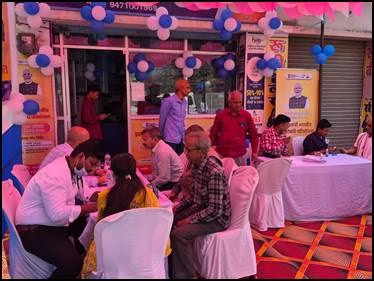
NEW DELHI — In a coordinated effort to dismantle the financial barriers to essential healthcare, the Ministry of Chemicals and Fertilizers on Sunday launched Janaushadhi Saptah 2026. The week-long initiative, which precedes the 8th National Janaushadhi Diwas on March 7, commenced with massive health check-up camps at more than 50 locations nationwide, providing thousands of citizens with free diagnostic services and immediate access to high-quality generic medicines.
From the bustling neighborhoods of Ashok Vihar in Delhi to the rural stretches of Chidambaram in Tamil Nadu, the first day of the campaign saw an average of 100 participants per site. Organized by the Pharmaceuticals and Medical Devices Bureau of India (PMBI), these camps are designed to address a critical paradox in Indian healthcare: while India is the “Pharmacy of the World,” nearly 55 million of its citizens fall into poverty annually due to out-of-pocket medical expenses.
Beyond Consultations: A “One-Stop” Health Hub
This year’s theme, “Jan Aushadhi Sasti Bhi, Bharosemand Bhi; Sehat Ki Baat, Bachat Ke Saath” (Jan Aushadhi: Affordable yet Reliable; Health Conversations with Savings), was reflected in the comprehensive nature of the camps.
Unlike standard outreach programs, the 2026 camps integrated specialized diagnostic services directly into the awareness drive. Key services offered included:
-
Free Laboratory Testing: Blood sugar, blood pressure, and thyroid screenings.
-
Specialist Consultations: Access to experts in nephrology, diabetology, and pediatrics.
-
Preventive Care: Eye check-ups and physiotherapy sessions.
-
Immediate Relief: Direct distribution of generic medicines for chronic and acute conditions.
“The goal is to show, not just tell, that quality healthcare is accessible,” said a senior PMBI official during the Delhi launch. “When a senior citizen receives a free thyroid test and then walks 10 steps to find their monthly medication at an 80% discount, the message of ‘affordable reliability’ becomes a lived reality.”
The Science of Savings: Are Generics Truly Equal?
The core of the Janaushadhi mission is to dispel the long-standing myth that lower price equates to lower quality. While branded medications are often sold at a premium to cover marketing and patent costs, generic drugs—like those found at Jan Aushadhi Kendras (JAKs)—are chemically identical versions produced after patent expiry.
A landmark study released in January 2026 by the Mission for Ethics and Science in Healthcare (MESH) provided timely validation for the government’s push. The study tested 131 medicines across 22 therapeutic categories, including treatments for heart disease and diabetes.
The Findings:
-
Quality Parity: Generic samples from government supply chains passed rigorous Indian Pharmacopoeia standards for drug content, dissolution, and impurities.
-
Price Disparity: Branded versions of the acidity drug pantoprazole were found to be up to 14 times more expensive than their Jan Aushadhi counterparts.
-
Adherence Benefit: Researchers noted that lower costs significantly improved treatment adherence, as patients were less likely to skip doses due to financial constraints.
“The data is clear: quality is not inherently linked to price,” says Dr. Cyriac Abby Philips, clinician-scientist and president of MESH. “Our testing shows that Jan Aushadhi medicines meet the same stringent benchmarks as the most expensive brands. For a patient on long-term medication, this can mean an annual saving of over ₹60,000.”
Public Health Implications and Road to 2027
The expansion of the Janaushadhi network is a pillar of India’s strategy to achieve Universal Health Coverage. As of March 2026, over 18,000 Kendras are operational, with the government setting an ambitious target of 25,000 outlets by March 2027.
According to the Economic Survey 2025-26, the PMBJP scheme has saved Indian citizens approximately ₹30,000 crore over the last decade. By providing over 2,100 types of medicines and 300 surgical items, the program is transitioning from a “poor man’s pharmacy” to a mainstream healthcare provider for all socioeconomic strata.
| Medication Type | Typical Branded Price (Strip) | Jan Aushadhi Price (Strip) | Estimated Savings |
| Anti-Diabetic (Metformin) | ₹21.20 | ₹6.60 | ~69% |
| Gastrointestinal (Pantoprazole) | ₹160.00 | ₹22.00 | ~86% |
| Cardiovascular (Atorvastatin) | ₹95.00 | ₹18.00 | ~81% |
Addressing the Skeptics
Despite the success, challenges remain. Some medical professionals express concern over the “batch-to-batch” consistency of generics from smaller manufacturers. Dr. Suranjit Chatterjee, Senior Consultant at Indraprastha Apollo Hospitals, notes that while the scheme is revolutionary, maintaining a seamless supply chain and ensuring the same “look and feel” of tablets is crucial for patient confidence.
“Patients, especially the elderly, get confused if their pill changes color or shape between refills,” Dr. Chatterjee explained. “Standardization and consistent availability are the next frontiers for the PMBJP.”
What This Means for You
For the average consumer, Janaushadhi Saptah is an invitation to audit their medical spending. Health authorities recommend the following steps:
-
Consult Your Doctor: Ask if your prescription can be substituted with a generic version.
-
Use the App: Download the “Jan Aushadhi Sugam” mobile app to find the nearest Kendra and compare prices in real-time.
-
Check the Quality: Look for the WHO-GMP (Good Manufacturing Practices) certification on the packaging, which ensures international production standards.
As health camps continue through March 5, the message from health officials is one of empowerment: healthcare should be a right, not a luxury.
Medical Disclaimer: This article is for informational purposes only and should not be considered medical advice. Always consult with qualified healthcare professionals before making any health-related decisions or changes to your treatment plan. The information presented here is based on current research and expert opinions, which may evolve as new evidence emerges.
References & Sources
-
Press Information Bureau (PIB) Delhi: “India’s Transformation into a Global Health Powerhouse,” March 1, 2026.