 0
0
 0
0
February 22, 2026
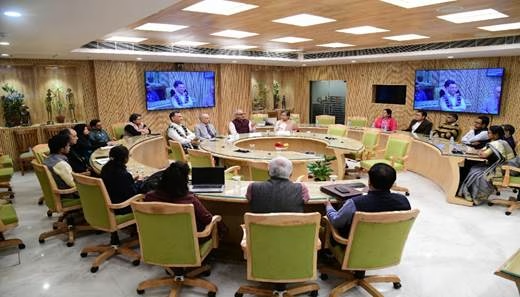
NEW DELHI — In a landmark move to fortify India’s defenses against the rising tide of natural and man-made catastrophes, three of the nation’s premier scientific and administrative bodies signed a Memorandum of Understanding (MoU) on Saturday. The National Disaster Management Authority (NDMA), the Academy of Scientific and Innovative Research (AcSIR), and the CSIR–National Institute of Science Communication and Policy Research (CSIR–NIScPR) have united to transform disaster management from a reactive response to a science-driven, proactive discipline.
The collaboration, finalized in New Delhi, establishes a formal framework for high-level academic research, policy development, and, crucially, the communication of risk to the public. By integrating the strategic oversight of the NDMA with the academic rigor of AcSIR and the communication expertise of CSIR–NIScPR, the initiative aims to bridge the long-standing gap between laboratory research and community-level preparedness.
A New Academic Frontier: The PhD in Disaster Management
One of the most significant outcomes of this MoU is the launch of a specialized PhD program in Disaster Management. Hosted at CSIR–NIScPR and accredited by AcSIR, the program is designed to cultivate a new generation of “disaster scientists.”
“We are nurturing experts who can develop innovative, research-based solutions to evolving challenges,” said Prof. Manoj Kumar Dhar, Director of AcSIR. With over 7,000 students already enrolled across various scientific domains, AcSIR’s entry into disaster research marks a pivotal shift toward interdisciplinary safety science.
For the average citizen, this means that future disaster policies will not just be administrative mandates but will be rooted in rigorous data—from seismic modeling and climate patterns to the sociological impacts of displacement.
Strengthening the “Last Mile” of Risk Communication
A recurring theme during the signing was the “Nine-Point Agenda on Disaster Risk Reduction” outlined by the Prime Minister. Central to this agenda is the necessity of effective communication. Historically, many health and safety crises in India have been exacerbated by “information voids”—periods where a lack of clear, scientific guidance leads to panic or misinformation.
Dr. Dinesh Kumar Aswal, Member of the NDMA, emphasized that the transformative potential of modern communication must be harnessed to save lives. “We must fully utilize communication channels to enhance early warning systems and community outreach,” Dr. Aswal noted.
Dr. Geetha Vani Rayasam, Director of CSIR–NIScPR, highlighted her institution’s unique role in this triad. As a leader in science communication, NIScPR will act as the “translator,” turning complex scientific data into actionable advice for the public. “Our goal is to support solutions that are scientifically robust and socially responsive,” Dr. Rayasam said.
Public Health Implications: Why This Matters to You
Disaster management is, at its core, a public health endeavor. Whether it is a heatwave, a flood, or a chemical leak, the primary “casualty” is human health—both physical and psychological.
1. Improved Early Warning Systems
The collaboration aims to refine how warnings are delivered. Research suggests that when people understand the why behind a safety alert, they are more likely to comply with evacuation orders or health advisories. This partnership will focus on making these alerts more intuitive and accessible to non-scientific audiences.
2. Evidence-Based Recovery
Post-disaster recovery often focuses on rebuilding infrastructure. However, this MoU emphasizes “systematic post-event studies.” This means scientists will study the long-term health outcomes of survivors—such as respiratory issues after wildfires or PTSD after earthquakes—to refine future medical responses.
3. Community Resilience
By institutionalizing a culture of continuous learning, the government intends to move toward the “Viksit Bharat 2047” vision, where every community is equipped with the knowledge to act as first responders before official help arrives.
Challenges and Limitations
While the MoU marks a significant step, experts note that the path to a “disaster-resilient India” faces hurdles. Historically, the challenge in India has not been a lack of scientific talent, but the “silo effect,” where different departments do not share data effectively.
Furthermore, while a PhD program creates high-level experts, the immediate need remains the rapid training of local municipal workers and rural health volunteers. Critics also point out that science-based policy must be backed by significant financial investment in local infrastructure to be truly effective.
The Path Forward
The tripartite agreement is more than a bureaucratic handshake; it is an admission that in an era of climate volatility, traditional governance is not enough. We need a “Science-Policy-Society” loop.
As the program rolls out, the NDMA will provide the strategic direction, AcSIR will provide the intellectual engine, and CSIR–NIScPR will ensure that the resulting knowledge reaches the people who need it most.
What this means for the reader: Stay informed through official channels, as the quality and clarity of the health and safety information you receive are about to undergo a scientific upgrade.
Reference Section
Official Sources:
-
Press Information Bureau (PIB) Delhi: “NDMA, AcSIR and CSIR–NIScPR Sign MoU to Strengthen Disaster Management Policy Research.” (Published Feb 21, 2026).
Medical Disclaimer: This article is for informational purposes only and should not be considered medical advice. Always consult with qualified healthcare professionals before making any health-related decisions or changes to your treatment plan. The information presented here is based on current research and expert opinions, which may evolve as new evidence emerges.