 0
0
 0
0
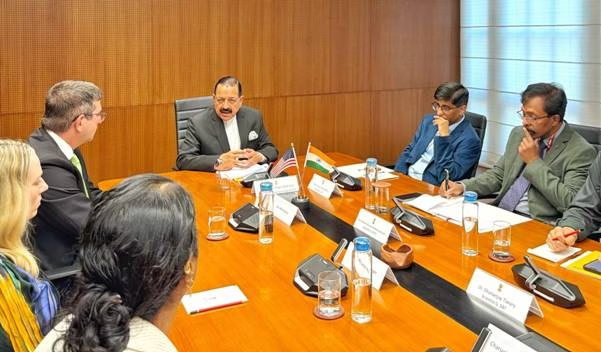
NEW DELHI — In a move that could reshape the global landscape for affordable life-saving medicines, India and the U.S. State of Delaware have proposed a new structured partnership focused on advanced biomanufacturing. Union Minister for Science and Technology Dr. Jitendra Singh announced the initiative on Monday, calling for a dedicated “working group” to fast-track collaborations in biotechnology research, startup ecosystems, and large-scale drug production.
The proposal, unveiled during a high-level meeting with a U.S. delegation led by Delaware Governor Matt Meyer, marks a significant shift toward state-level diplomacy within the broader India-U.S. strategic framework. By linking India’s massive, cost-efficient manufacturing engine with Delaware’s high-tech research corridor, officials aim to drive down the cost of next-generation therapies for patients worldwide.
A Convergence of Innovation and Scale
At the heart of the proposal is a strategic trade-off: Delaware offers proximity to the world’s leading pharmaceutical giants and world-class research institutions like the National Institute for Innovation in Manufacturing Biopharmaceuticals (NIIMBL). India, conversely, offers an unparalleled “integrated innovation architecture.”
Dr. Singh highlighted the Council of Scientific and Industrial Research (CSIR), which operates 37 laboratories and employs over 7,500 scientists, as a primary anchor for this partnership. “Science, technology, and biotechnology form a key pillar of our comprehensive strategic partnership,” Singh noted, emphasizing that India is no longer just the “pharmacy of the world” for generic pills, but an emerging hub for complex biologics.
Key Pillars of the Proposed Partnership:
-
Joint Biomanufacturing Platforms: Collaborative facilities to develop and scale up “biosimilars”—highly potent, lower-cost versions of expensive brand-name biological drugs.
-
AI-Enabled Processes: Utilizing artificial intelligence to optimize drug yields and reduce the time it takes to move a molecule from the lab to the patient.
-
Workforce Training: Joint programs in Good Manufacturing Practices (GMP) and regulatory science to ensure Indian and American facilities meet the highest international safety standards.
-
Resilient Supply Chains: Reducing global dependency on single-source suppliers for critical raw materials used in vaccine and drug production.
Expert Perspectives: Why Local Matters Global
Public health experts suggest that state-to-state partnerships like this one are crucial for addressing “biotherapeutic deserts”—regions where advanced treatments for cancer, diabetes, and rare diseases are financially out of reach.
“The bottleneck in global health today isn’t just discovering a drug; it’s making it at a price point that 8 billion people can afford,” says Dr. Aranya Gupta, a global health policy analyst not involved in the talks. “Delaware’s expertise in regulatory science combined with India’s ability to scale is a potent combination for global health equity.”
Governor Matt Meyer echoed this sentiment, describing Delaware as a state with a “long-standing science and industrial heritage.” With its expanding port infrastructure and a business-friendly environment that houses a large percentage of Fortune 500 companies, Delaware serves as a gateway for Indian biotech startups looking to enter the North American market.
Impact on the Patient: From Lab to Living Room
For the average consumer, this diplomatic move could eventually translate to lower pharmacy bills and faster access to new vaccines. While traditional drugs are chemical-based (small molecules), biologics are derived from living organisms. They are significantly more complex to manufacture—Dr. Singh compared the difference to that between building a bicycle and a jumbo jet.
By harmonizing regulatory standards between Delaware’s hubs and Indian labs, the “time-to-market” for new therapies could be slashed. This is particularly relevant for:
-
Next-Generation Vaccines: Rapidly scaling production for emerging viral threats.
-
Affordable Cancer Care: Bringing down the cost of monoclonal antibodies and CAR-T cell therapies.
-
Diabetes Management: Increasing the global supply of affordable insulin and biosimilar injectables.
Challenges and Counterarguments
Despite the optimism, the path to a seamless India-Delaware corridor faces hurdles. Intellectual Property (IP) remains a sensitive point of negotiation in India-U.S. trade talks. Additionally, critics argue that state-level agreements can sometimes lack the “teeth” of federal treaties, potentially leading to fragmented regulatory oversight if not managed by a robust central framework.
Furthermore, the integration of AI into biomanufacturing raises questions about data privacy and the potential for “digital divides” in manufacturing technology. The proposed working group will need to address these “deep-tech” challenges to ensure that innovation does not outpace safety.
Looking Ahead
The meeting concluded with a mutual agreement to establish a structured mechanism to oversee joint research calls and startup exchanges. With the Indian government recently establishing a ₹1 lakh crore ($12 billion) R&D fund to catalyze deep-tech investment, the financial fuel for this partnership appears ready.
As these two innovation hubs align, the goal remains clear: transforming the high-cost “luxury” of biotechnology into a standard of care accessible to all.
References
Official Sources:
-
Press Information Bureau (PIB), Government of India. “Dr. Jitendra Singh Proposes India–Delaware Biomanufacturing Working Group.” (March 2, 2026).
Medical Disclaimer: This article is for informational purposes only and should not be considered medical advice. Always consult with qualified healthcare professionals before making any health-related decisions or changes to your treatment plan. The information presented here is based on current research and expert opinions, which may evolve as new evidence emerges.