 0
0
 0
0
BENGALURU — In a significant move to modernize traditional medicine, the Government of India has officially opened a national “Call for Expression of Interest” (EoI) for Ayurveda startups. This initiative, centered at the newly established Ayurvedic Sciences Incubation Centre (ASIC) in Bengaluru, marks a strategic pivot toward evidence-based traditional healthcare, aiming to transform classical Vedic knowledge into commercially viable, globally competitive medical solutions.
Announced on February 27, 2026, by the Ministry of Ayush, the program seeks to bridge the gap between ancient texts and modern clinical standards. By offering a structured ecosystem of mentorship, funding, and regulatory guidance, the government intends to position India as the global epicenter for “Integrative Healthcare”—a discipline that combines conventional medicine with traditional systems.
A Launchpad for the “Ayur-Entrepreneur”
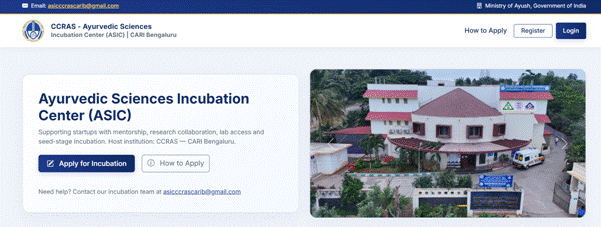
The ASIC is hosted at the Central Ayurveda Research Institute (CARI) in Bengaluru, a premier facility under the Central Council for Research in Ayurvedic Sciences (CCRAS). The center is not merely a workspace but a specialized laboratory for innovation.
Shri Prataprao Jadhav, Union Minister of State (Independent Charge) for the Ministry of Ayush, emphasized that the initiative is designed to empower a new generation of “Ayur-entrepreneurs.”
“The Ayurvedic Sciences Incubation Centre will empower young innovators to translate classical knowledge into contemporary healthcare solutions,” Jadhav stated. “This is a critical step in strengthening India’s emergence as a global hub for integrative healthcare.”
Key Resources Offered to Startups:
-
Scientific Mentorship: Access to senior researchers for drug standardization and medicinal plant studies.
-
Regulatory Facilitation: Guidance through the complex landscape of Ayush licensing and international export standards.
-
Accredited Infrastructure: Startups will have access to NABH (National Accreditation Board for Hospitals & Healthcare Providers) and NABL (National Accreditation Board for Testing and Calibration Laboratories) accredited facilities.
-
Financial Guidance: Connections to investors and government grants specifically earmarked for the Ayush sector.
Why Now? The Push for Evidence-Based Ayurveda
For decades, traditional medicine has faced skepticism regarding its lack of standardized clinical data. The Ministry of Ayush is looking to change that narrative by embedding startups within a research-heavy environment.
Vaidya Rajesh Kotecha, Secretary of the Ministry of Ayush, noted that ASIC reflects a strategic priority to build a “robust startup ecosystem.” The focus is strictly on research-backed products. This means that instead of simply repackaging old formulas, startups are encouraged to use modern biotechnology, pharmacology, and data analytics to validate how Ayurvedic compounds interact with human biology.
“CARI Bengaluru is already recognized as a Centre of Excellence in Madhumeha (Diabetes),” says Dr. Sulochana Bhat, Head of CARI. “We are committed to mentoring startups in developing scientifically validated solutions that can stand up to global scrutiny.”
Public Health Implications: Preventive and Sustainable Care
The shift toward a formalized Ayurveda startup sector has broader implications for public health. As the global burden of non-communicable diseases (NCDs) like diabetes, hypertension, and obesity rises, there is a growing demand for preventive and promotive healthcare.
“Modern medicine is excellent for acute care and emergencies, but traditional systems like Ayurveda offer profound insights into lifestyle-based prevention,” says Dr. Ananya Sharma, an independent public health consultant not affiliated with the CCRAS. “If these startups can deliver standardized, easy-to-use, and proven interventions, it could significantly reduce the long-term strain on our primary healthcare infrastructure.”
However, experts caution that “contemporary healthcare solutions” must remain grounded in safety. The inclusion of the Peripheral Pharmacovigilance Centre at CARI ensures that any new product developed under the ASIC umbrella will be monitored for adverse effects—a crucial step in building consumer trust.
Balancing Tradition with Rigorous Science
While the enthusiasm is high, the road to “translating classical knowledge” is fraught with challenges. One of the primary hurdles is standardization. Unlike synthetic drugs, Ayurvedic formulations involve complex botanical extracts where the chemical composition can vary based on soil, climate, and harvest time.
Independent observers point out that for Indian Ayurveda startups to succeed in markets like the US or EU, they must go beyond “tradition” and invest heavily in:
-
Phytochemical Profiling: Identifying the exact active compounds in a formula.
-
Double-Blind Clinical Trials: The gold standard for proving efficacy.
-
Sustainable Sourcing: Ensuring that the surge in demand for medicinal plants does not lead to ecological degradation.
Prof. Rabinarayan Acharya, Director General of CCRAS, acknowledged these needs, stating that ASIC will serve as a “catalyst for innovation-driven growth,” specifically promoting industry-academia collaboration to solve these technical bottlenecks.
How to Apply: A Digital Gateway for Innovators
The application process has been streamlined to encourage participation from tech-savvy innovators. Interested parties have until March 25, 2026, to submit their proposals.
The Three-Step Application Process:
-
Registration: Sign up on the official ASIC portal using an official email ID.
-
Profile Building: Provide details regarding the team, the specific product idea, and the current stage of development (Ideation, MVP, or Scaling).
-
Problem Statement: Clearly define the healthcare problem being addressed and the proposed Ayurvedic solution, backed by preliminary data or literature.
The Road Ahead
As the deadline approaches, the move signals a new era for the Ayush sector—one where “startup culture” meets “ancient culture.” If successful, the ASIC model could be replicated across other traditional systems like Unani, Siddha, and Homeopathy, creating a diversified portfolio of Indian healthcare exports.
For the consumer, this means that in the coming years, the “Ayurvedic” label on a product may carry the weight of NABL-certified research and clinical validation, making traditional wellness a more integrated part of modern medical prescriptions.
References & Sources
-
Primary Source: Press Information Bureau (PIB) Delhi, Ministry of Ayush. (Posted 27 Feb 2026). National Call for Expression of Interest Invites Ayurveda Startups.
Medical Disclaimer: This article is for informational purposes only and should not be considered medical advice. Always consult with qualified healthcare professionals before making any health-related decisions or changes to your treatment plan. The information presented here is based on current research and expert opinions, which may evolve as new evidence emerges.