 0
0
 0
0
December 29, 2025
For decades, neuroscientists have described human attention as a “spotlight”—a steady beam that illuminates what we need to see while leaving the rest of the world in the shadows. However, groundbreaking new research has revealed that this spotlight doesn’t just shine; it pulses.
A study led by Dr. Jiang Yi at the Institute of Psychology of the Chinese Academy of Sciences, published in Nature Communications on November 17, 2025, has finally mapped the “rhythm” of our minds. The research provides the first clear evidence that conscious visual awareness acts as a sophisticated “conductor,” fine-tuning the speed and precision of how our brains sample information from the environment.
This discovery doesn’t just change how we understand the “flicker” of human thought; it offers a potential roadmap for treating cognitive disorders where this internal rhythm goes off-beat.
The Pulsing Mind: Rethinking the Attention Spotlight
To understand this breakthrough, one must first discard the idea that we take in the world like a continuous video stream. In reality, our brains function more like a camera taking rapid-fire snapshots. This process, known as rhythmic sampling, typically occurs at a frequency of 4 to 8 cycles per second (Hertz).
Until now, scientists struggled to answer a fundamental question: Do we need to be aware of something for our attention to start pulsing, or does the pulsing happen automatically in the background?
“We’ve known for some time that attention oscillates,” says Dr. Yang Fang, the study’s first author. “What we didn’t know was how consciousness changes that beat. Is awareness just an ‘on-off’ switch, or does it do something more?”
The “Invisible” Experiment
The research team employed a sophisticated technique called chromatic flicker fusion to hide visual cues from participants’ conscious minds. By rapidly alternating two gratings of opposite colors at 30 Hz—a speed faster than the human eye can process—they created “invisible” cues. To the participants, these cues were indistinguishable from the background; however, their brains still registered them at a subconscious level.
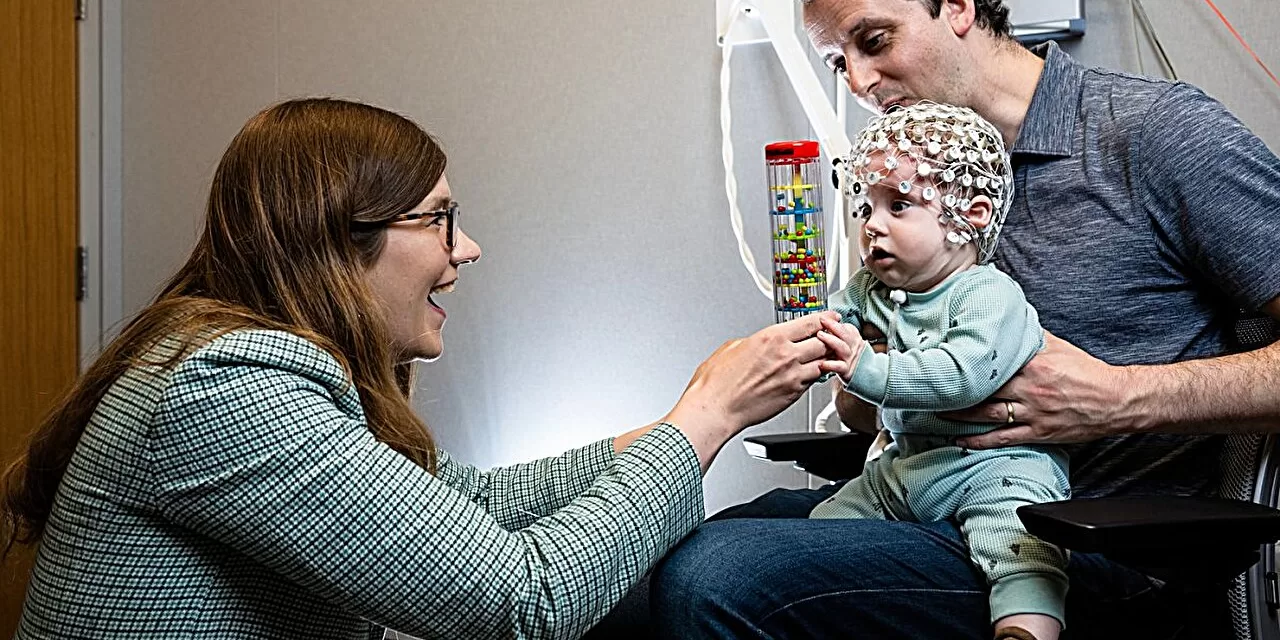
By comparing these invisible cues with visible ones using electroencephalography (EEG) and high-resolution tracking, the researchers observed a stark difference in how the brain behaved:
-
The Subconscious Pulse: When cues were invisible, the brain still sampled information, but at a sluggish pace of approximately 4 Hz.
-
The Conscious Boost: When participants were consciously aware of the cues, the sampling rate doubled to approximately 8 Hz.
“The results show that rhythmic attentional sampling can be induced even by things we don’t ‘see,'” explains Dr. Jiang Yi. “But once awareness kicks in, the system shifts into high gear.”
Key Findings: Precision, Speed, and Silence
The study highlights three specific ways that consciousness “conducts” the orchestra of the brain:
-
Accelerated Sampling: Awareness moves the “metronome” of attention from a slow 4 Hz crawl to a brisk 8 Hz sprint, allowing for faster processing of changing environments.
-
Enhanced Distractor Suppression: Conscious awareness acted as a “noise-canceling” feature. It didn’t just help participants focus on the target; it actively silenced the neural “noise” of distractions.
-
Neural Coherence: The EEG data showed that consciousness fostered “large-scale neural coordination.” Specifically, it strengthened the communication between the frontal region (the brain’s executive center) and the occipito-parietal regions (where visual information is processed).
Expert Commentary: Why This Matters
Independent experts suggest this study fills a massive gap in cognitive science.
“This is a milestone in consciousness research,” says Dr. Elena Rossi, a cognitive neuroscientist not involved in the study. “For years, we treated attention and consciousness as nearly the same thing. This study proves they are distinct but deeply interactive. Attention provides the mechanism, but consciousness provides the optimization.”
Dr. Rossi notes that the finding regarding “distractor suppression” is particularly vital. “In an age of digital overstimulation, understanding how the conscious mind filters out irrelevant ‘noise’ at a millisecond level is crucial for understanding how we maintain focus.”
Implications for Public Health and Clinical Treatment
While the study was conducted in a controlled lab setting, the implications for public health are far-reaching. Many cognitive and neurological conditions are characterized by “glitches” in how the brain filters information.
-
ADHD and Focus Disorders: If consciousness is the “conductor” that speeds up sampling and suppresses distractors, deficits in these rhythms might explain the distractibility seen in ADHD.
-
Aging and Cognitive Decline: As we age, our neural “processing speed” often slows down. This research suggests that targeting the synchronization between the frontal and visual centers of the brain could potentially help maintain cognitive sharpness.
-
Autism Spectrum Disorder: Some researchers believe that sensory overload in autism may be linked to an inability to “dampen” background stimuli—a process this study shows is heavily regulated by conscious awareness.
Limitations and Future Research
As with any frontier-science study, there are caveats. The research focused strictly on visual awareness. It remains to be seen if the same “conductor” effect applies to our sense of hearing or touch. Furthermore, the study was conducted on a healthy population; how these rhythms behave in brains with pre-existing neurological conditions is the next necessary step for clinical application.
“We are just scratching the surface,” says Dr. Yang. “Visual awareness is not just a passive experience of ‘seeing.’ It is a powerful regulator that makes our attention more flexible, selective, and efficient.”
What This Means for You
For the average person, this research validates the “mental fatigue” we feel when multitasking or in high-stress environments. Since consciousness requires significant neural energy to “speed up” our internal sampling rate and “silence” distractions, we have a limited capacity for high-level focus.
Practical Takeaways:
-
Respect the “Refractory Period”: Your brain takes snapshots; it doesn’t see a movie. Give yourself breaks to allow these neural rhythms to reset.
-
Minimize “Invisible” Distractors: Even things you aren’t consciously focusing on (like a flickering light or background TV) can trigger the brain’s 4 Hz subconscious sampling, draining “computational power” from your conscious tasks.
References
-
Study Citation: Fang, Y., et al. (2025). Visual awareness sharpens and accelerates attentional sampling through enhancing inhibitory neural modulation in the attention network. Nature Communications. DOI: 10.1038/s41467-025-64987-7.
Medical Disclaimer: This article is for informational purposes only and should not be considered medical advice. Always consult with qualified healthcare professionals before making any health-related decisions or changes to your treatment plan. The information presented here is based on current research and expert opinions, which may evolve as new evidence emerges.