 0
0
 0
0
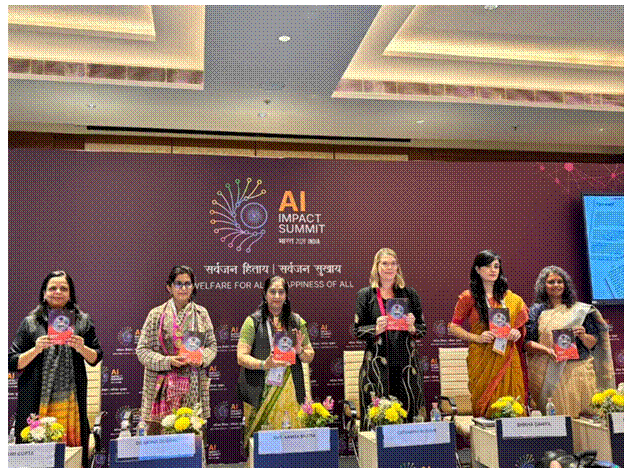
NEW DELHI – In a landmark move to bridge the gap between technological promise and clinical reality, the Government of India launched the AI Impact Casebooks – Health & Education during the high-level India AI Impact Summit 2026. Developed in collaboration with the World Health Organization (WHO), these compendiums mark a shift from experimental “pilot projects” to scalable, real-world AI applications designed to transform healthcare delivery across the Global South.
The launch, held at the Bharat Mandapam on February 17, 2026, was spearheaded by the Ministry of Health & Family Welfare (MoHFW) and the IndiaAI Mission. The casebooks provide a practical blueprint for integrating Artificial Intelligence (AI) into public health systems, focusing on measurable patient outcomes and ethical governance.
From Promise to Practice: The Health Casebook
The Casebook on Real-World Impact of AI in Health features 24 detailed chapters and 12 snapshot previews of AI innovations currently deployed in clinics and community settings. Unlike previous reports that focused on theoretical potential, this compendium highlights technologies that are already reducing physician workloads and improving diagnostic accuracy.
“This compendium is meant to move the conversation on artificial intelligence from promise to practice,” stated Ms. Catharina Boehme, Officer-in-Charge for the WHO South-East Asia Region. She emphasized that AI is no longer just a futuristic concept but a vital tool for tackling the “growing health issues, workforce challenges, and service delivery issues” faced by nations today.
Key Focus Areas:
-
Rural Accessibility: AI-powered telemedicine and symptom checkers are connecting remote patients to specialists, significantly cutting down travel time and costs.
-
Precision Diagnostics: AI-based medical image analysis is being utilized for the early detection of Tuberculosis (TB), various cancers, and other chronic conditions in areas with limited access to radiologists.
-
Workforce Support: Tools designed to automate administrative tasks—such as patient intake and data entry—are being deployed to allow clinicians to focus more on direct patient care.
Strategic Governance and Ethical Guardrails
A central theme of the summit was the necessity of “Responsible AI.” The casebooks emphasize a framework of ethical governance, interoperability, and accountability. With India’s Ayushman Bharat Digital Mission (ABDM) now boasting over 859 million linked health accounts, the integration of AI is built upon a robust Digital Public Infrastructure (DPI).
Kavita Bhatia, Scientist G and Group Coordinator at MeitY, acknowledged the “globally benchmarked, evidence-based selection process” led by the ICMR and WHO. This process ensures that the featured AI solutions are not only innovative but also safe, transparent, and culturally contextual.
Expert Perspectives: A Balanced View
While the summit celebrated these advancements, independent experts urge a cautious approach to implementation. Dr. Amandeep Gill, UN Special Envoy for Digital and Emerging Technologies, noted that while AI can equalize access, it requires strong “technical and ethical capacity” to ensure that algorithmic biases do not worsen existing health disparities.
“AI has the potential to reduce the burden on the healthcare workforce while strengthening, not replacing, the physician-patient relationship,” said Punya Salila Srivastava, Union Health Secretary. She highlighted that the transition from basic digitization to a nationally interoperable ecosystem is the “Sutra” (guiding principle) for India’s success.
However, critics point out that the digital divide remains a hurdle. For AI to truly impact the “last mile,” local infrastructure—such as high-speed internet in Tier-3 cities and consistent power supply for medical devices—must keep pace with software innovations.
What This Means for Consumers
For the average citizen, the launch of these casebooks signals a future where healthcare is more proactive and personalized.
-
Smarter Care: AI tools are increasingly able to analyze longitudinal health data to predict disease trajectories before clinical symptoms appear.
-
Language Inclusivity: New AI models are breaking down barriers by providing medical information and diagnostic support in regional languages.
-
Enhanced Safety: The “Safe and Trusted AI” pillar of the IndiaAI Mission is working to ensure that medical AI models are audited for bias and accuracy before they reach the patient.
Implications for Public Health
The India AI Impact Summit 2026 positions India as a leader in the Global South, offering a scalable model for other developing nations. By documenting success stories and failures in these casebooks, the government aims to create a “knowledge repository” that allows for the rapid replication of effective AI interventions.
As AI moves into the mainstream of the Indian healthcare system, the focus remains on ensuring these tools serve the public interest, maintain patient privacy, and deliver measurable improvements in the quality of life.
Reference Section
-
PIB Delhi (2026, Feb 17): AI Impact Casebooks – Health & Education Launched at India AI Impact Summit 2026. [Release ID: 2229305].
Medical Disclaimer: This article is for informational purposes only and should not be considered medical advice. Always consult with qualified healthcare professionals before making any health-related decisions or changes to your treatment plan. The information presented here is based on current research and expert opinions, which may evolve as new evidence emerges.
AI Implementation in Public Healthcare
This video features a panel of experts at the India AI Impact Summit 2026 discussing the practical challenges and strategies for implementing AI in public healthcare at the grassroots level.