 0
0
 0
0
MUMBAI, India — For decades, India has carried the mantle of the “Pharmacy of the World,” a title earned by flooding global markets with high-quality, low-cost generic life-savers. But as of February 2026, the narrative is shifting from imitation to innovation.
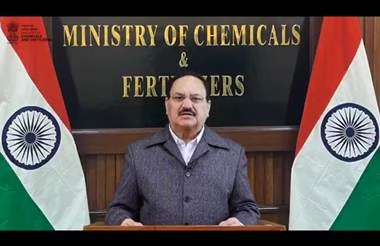
Speaking at the 11th Global Pharmaceutical Quality Summit in Mumbai via video message, Union Minister for Chemicals and Fertilizers, Shri Jagat Prakash Nadda, declared that India has entered a transformative era. Under a new strategic framework, the nation is pivoting from a volume-driven manufacturing base to a value-driven “Global Innovation Hub.”
“This transformation is driven by a strong focus on healthcare security, manufacturing resilience, and scientific excellence,” Minister Nadda stated. He emphasized that for India to anchor global supply chains in the coming decade, it must lead through “quality, reliability, and innovation,” not just sheer scale.
The Power of ‘SHAKTI’: A ₹10,000 Crore Catalyst
At the heart of this transition is the newly launched Biopharma SHAKTI (Strategy for Healthcare Advancement through Knowledge, Technology, and Innovation) initiative. Backed by a ₹10,000 crore (approximately $1.2 billion) outlay over five years, the program aims to build a self-reliant ecosystem for the domestic production of biologics and biosimilars—complex drugs derived from living organisms that are essential for treating cancer, diabetes, and autoimmune disorders.
The initiative aligns with India’s ambitious goal: to capture 5% of the global biopharmaceutical market share by 2030. Currently, while India produces 20% of the world’s generic drugs by volume, it accounts for only about 14% of the global industry value, highlighting a significant “value gap” that the government is eager to close.
From Lab to Bedside: Expanding Research Infrastructure
The Minister also highlighted the Promotion of Research and Innovation in Pharma MedTech (PRIP) scheme. This ₹5,000 crore program is designed to move the needle on R&D by focusing on:
-
New Chemical Entities (NCEs): Discovering entirely new drug molecules.
-
Complex Generics: Developing difficult-to-make versions of sophisticated medicines.
-
Advanced Medical Technologies: Innovating in the MedTech space, including precision diagnostics.
To support this, the government is expanding its academic and clinical backbone. Plans are underway to establish three new National Institutes of Pharmaceutical Education and Research (NIPERs) and upgrade seven existing ones. Perhaps most critically for clinical efficacy, a network of over 1,000 accredited clinical trial sites is being developed across the country to streamline drug development and ensure global-grade data integrity.
The Role of Intelligence: AI and Quality Systems
The “innovation hub” vision isn’t just about molecules; it’s about the systems that manage them. Minister Nadda underscored the “responsible use of artificial intelligence” in strengthening:
-
Predictive Diagnostics: Identifying diseases before they become acute.
-
Pharmacovigilance: Using AI to monitor drug safety and side effects in real-time.
-
Traceability: Ensuring the integrity of the supply chain to combat counterfeit medicines.
“Quality must be embedded as a core organizational value rather than treated merely as a compliance requirement,” Nadda urged industry leaders. This shift suggests a move toward “Quality by Design,” where safety and efficacy are built into the manufacturing process from day one.
Expert Perspectives: The Road Ahead
Industry experts see this as a necessary evolution. “The future of Indian pharma is not only about making medicines more affordable, but also about making them more advanced,” says Kiran Mazumdar-Shaw, Chairperson of Biocon Group. She noted that the budget’s emphasis on biologics positions India to improve treatment options for non-communicable diseases (NCDs), which now account for over 57% of deaths in India.
However, the transition faces hurdles. Historically, Indian firms have allocated roughly 6-12% of revenue to R&D, whereas global innovators often exceed 15-20%.
“The challenge is moving from a cost-based model to a risk-taking discovery model,” explains Dr. Hari Kiran Chereddi, CEO of HRV Pharma. “The government’s push provides the safety net, but the industry must now show the appetite for long-term research.”
What This Means for Patients
For the average consumer, this shift promises more than just economic growth. By localizing the production of high-value biologics and rare disease drugs—many of which are currently imported at exorbitant costs—the government aims to make “cutting-edge” therapy as accessible as “generic” therapy.
In tandem with these initiatives, the government recently waived basic customs duty on 17 cancer medicines, a move intended to provide immediate relief while the domestic innovation engine ramps up.
Key Statistics at a Glance
| Metric | Current Status (2024-25) | Target / Projection (2030-2047) |
| Industry Valuation | $55 Billion | $450 Billion (by 2047) |
| Global Market Share (Value) | ~3-6% | 5% (Biopharma specifically) |
| Pharma Exports | ~$30 Billion | $350 Billion (by 2047) |
| Clinical Trial Sites | Fragmented/Metro-centric | 1,000+ Accredited Sites |
References
-
Press Information Bureau (PIB). (2026, Feb 23). India is Transitioning from “Pharmacy of the World” to a “Global Innovation Hub”- Union Minister Shri Jagat Prakash Nadda. Release ID: 2231846.
Medical Disclaimer: This article is for informational purposes only and should not be considered medical advice. Always consult with qualified healthcare professionals before making any health-related decisions or changes to your treatment plan. The information presented here is based on current research and expert opinions, which may evolve as new evidence emerges.