 0
0
 0
0
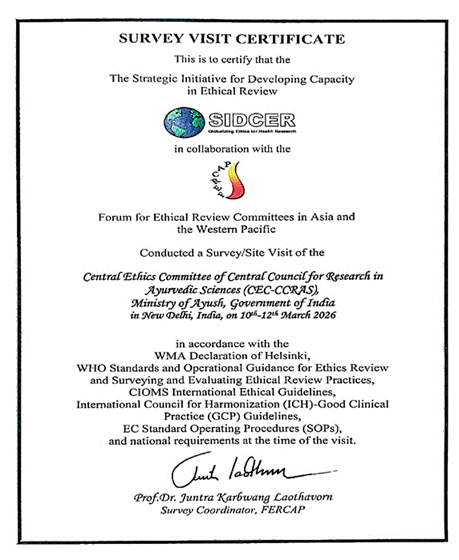
NEW DELHI — In a landmark move for traditional medicine research, the Central Ethics Committee (CEC) of the Central Council for Research in Ayurvedic Sciences (CCRAS) has successfully completed a rigorous international evaluation. The assessment, conducted from March 9 to 12, 2026, marks the first time an ethics committee within India’s Ayush sector (Ayurveda, Yoga, Naturopathy, Unani, Siddha, and Homeopathy) has sought and undergone such a high-level external audit.
The evaluation was performed by the Strategic Initiative for Developing Capacity in Ethical Review (SIDCER), operating under the Forum for Ethical Review Committees in the Asian and Western Pacific Region (FERCAP). This move signals a significant shift toward aligning traditional Indian medicine research with the same stringent global ethical standards applied to conventional pharmaceutical trials.
Elevating the Standards of Patient Safety
The primary goal of an ethics committee is to act as a guardian for human participants in clinical trials. They ensure that any research study is designed to minimize risk, protect patient privacy, and ensure that “informed consent” is truly informed.
By inviting SIDCER-FERCAP—a global leader in ethics accreditation—CCRAS is effectively opening its books to international scrutiny. The survey team, composed of two international experts and three Indian surveyors, conducted a deep-dive assessment into the CEC’s operational standards, decision-making transparency, and compliance with both national and international bioethics guidelines.
“This is not just a procedural check-mark,” says Dr. Aradhana Sharma, a bioethics consultant not involved with the CCRAS study. “When an institution of this magnitude undergoes a SIDCER evaluation, they are committing to a level of accountability that reassures both the scientific community and the general public that Ayurvedic research is being held to the highest moral and scientific scrutiny.”
A First for the Ayush Sector
While 17 Indian institutions specializing in contemporary medical sciences (allopathy) have previously undergone this evaluation, CCRAS is the pioneer for the Ayush sector. This distinction is vital for the global acceptance of Ayurvedic medicine.
Historically, traditional medicine has sometimes faced skepticism regarding the methodology and ethical oversight of its clinical trials. The CCRAS initiative aims to dismantle these barriers.
Key Aspects of the Evaluation:
-
Transparency: Ensuring that the process of approving a study is free from conflict of interest.
-
Participant Protection: Verifying that the risks to volunteers are outweighed by the potential benefits to society.
-
Operational Excellence: Standardizing the documentation and follow-up procedures for ongoing clinical trials.
-
Regulatory Alignment: Ensuring compliance with the Indian Council of Medical Research (ICMR) guidelines and international Good Clinical Practice (GCP).
The Global Context: Why This Matters for You
For the average health-conscious consumer, this news may seem like “inside baseball” for scientists. However, the implications for public health are direct. When ethics committees are internationally benchmarked, the data produced by the studies they oversee becomes more credible.
If you are considering an Ayurvedic treatment for a chronic condition, you want to know that the research backing that treatment was conducted safely and honestly. This evaluation provides a “seal of quality” that the underlying research governance at CCRAS meets the same criteria as a leading global university or a major pharmaceutical firm.
“The exercise is expected to elevate the standards of ethics governance within the Ayush research ecosystem to an international level,” noted a spokesperson from the Ministry of Ayush during the announcement. “It serves as a model for other premier Ayush institutions to emulate.”
Balancing Tradition with Modern Rigor
The integration of ancient wisdom with modern ethical frameworks does present challenges. Traditional treatments often involve complex, multi-ingredient formulations rather than single chemical entities. Evaluating the “ethics” of such trials requires a nuanced understanding of both the traditional philosophy and modern safety protocols.
Critics of rapid expansion in traditional medicine research often point to the need for better “pharmacovigilance”—the monitoring of side effects. A robust ethics committee is the first line of defense in identifying these risks before a product reaches the mass market.
The Path Forward
The successful completion of this survey is expected to lead to official SIDCER recognition, placing CCRAS on a global map of certified ethics committees. For the broader Ayush ecosystem, this sets a “New Benchmark.” It encourages other bodies, such as the National Commission for Indian System of Medicine (NCISM), to push for similar certifications across regional research centers.
As India continues to position itself as a global hub for traditional medicine, the move by CCRAS demonstrates that “tradition” and “global standards” are not mutually exclusive. Instead, they are the two pillars upon which the future of integrated healthcare will be built.
Reference Section
Primary Source:
-
Press Information Bureau (PIB) Delhi. “Central Ethics Committee of CCRAS (CEC CCRAS) Undergoes International Evaluation by SIDCER-FERCAP.” Published March 13, 2026.
Medical Disclaimer: This article is for informational purposes only and should not be considered medical advice. Always consult with qualified healthcare professionals before making any health-related decisions or changes to your treatment plan. The information presented here is based on current research and expert opinions, which may evolve as new evidence emerges.