 0
0
 0
0
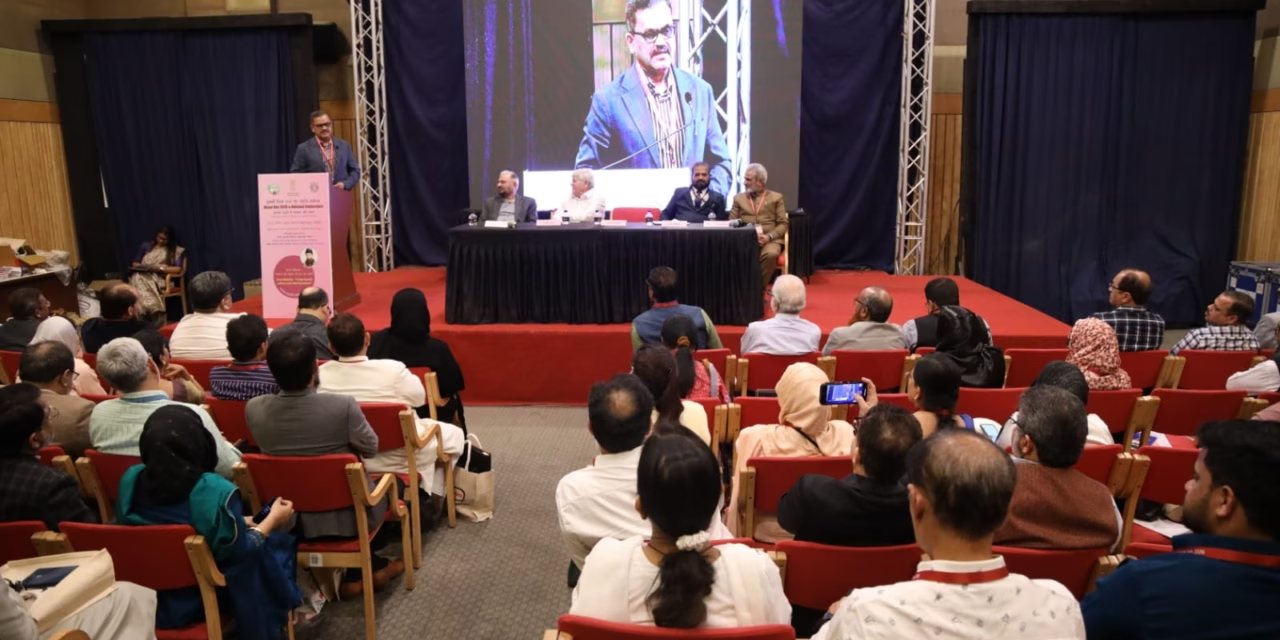
MUMBAI — As the global healthcare landscape shifts toward personalized and integrative medicine, the Central Council for Research in Unani Medicine (CCRUM) concluded its 2026 National Conference this weekend, marking a decisive pivot for one of the world’s oldest healing systems. The two-day event, titled “Innovation and Evidence in Unani Practice,” brought together hundreds of researchers, policymakers, and clinicians to bridge the gap between Greco-Arabic traditional knowledge and 21st-century medical rigor.
The conference, which coincided with the annual Unani Day celebrations on February 14th, served as a platform for the Ministry of Ayush to announce significant technological upgrades and international collaborations aimed at “mainstreaming” Unani healthcare through scientific validation.
A New Era of Scientific Validation
The headline development of the summit was the focus on transforming Unani from a purely traditional practice into an “evidence-based” medical discipline. Prataprao Jadhav, Union Minister of State for the Ministry of Ayush, inaugurated a newly renovated Co-location Centre at the historic J. J. Hospital campus in Mumbai. This move is seen as a physical manifestation of “integrative medicine,” where Unani practitioners work alongside modern medical professionals.
“Strengthening clinical research and patient-care infrastructure is not just about better buildings,” Minister Jadhav noted during the inauguration. “It is about creating an environment where traditional therapies can be tested and verified using the highest scientific standards.”
To support this claim, the Regional Research Institute of Unani Medicine (RRIUM) in Mumbai officially received NABL (National Accreditation Board for Testing and Calibration Laboratories) certification for its laboratories. In the world of medical research, NABL accreditation is the “gold standard,” ensuring that the data generated by these labs is accurate, reliable, and internationally recognized.
The Intersection of Tradition and Technology
Perhaps the most surprising shift discussed in Mumbai was the integration of high-tech tools like Artificial Intelligence (AI) and Genomics into Unani research.
Traditionally, Unani medicine relies on the concept of Mizaj (temperament)—the unique internal balance of an individual. At the conference, researchers presented a new digital Questionnaire for Assessment of Mizaj Insa, a tool designed to standardize how practitioners determine a patient’s temperament.
Experts at the conference, including Dr. Mohammed Idris and Prof. B. Vijaya Lakshmi, led sessions on how AI can be used to predict patient responses to specific herbal formulations. By mapping the genetic profiles of patients (genomics), researchers hope to explain why certain Unani treatments work more effectively for some individuals than others, moving toward a “personalized medicine” model that mirrors modern oncology and pharmacology.
Nine Pillars of Progress
The conference was organized into nine scientific sessions, each tackling a critical component of modernizing the practice:
-
Drug Standardization: Ensuring that herbal medicines have consistent potency and are free from contaminants.
-
Ilaj-bil-Ghiza (Dietotherapy): Collaborating with the Food Safety and Standards Authority of India (FSSAI) to use food as a primary tool for disease prevention.
-
Ilaj-bil-Tadbir (Regimenal Therapy): Investigating the physiological effects of therapies like cupping (Hijama), massage, and leeches through a clinical lens.
-
Translational Research: Moving discoveries from the laboratory bench to the patient’s bedside more efficiently.
Global Outreach and Public Health
The conference was not merely academic; it had clear implications for global public health. The CCRUM announced the exchange of one international and eight national Memorandums of Understanding (MoUs), signaling an intent to export Unani principles to the global market.
Prof. Asim Ali Khan, President of the Board of Unani, Siddha & Sowa-Rigpa (BUSS), emphasized that for Unani to be accepted globally, it must move beyond anecdotal success stories. “We need stronger academic standards and scientific validation to ensure global recognition,” Khan stated during the valedictory session.
For the average consumer, this means that Unani treatments for chronic conditions—such as skin disorders, liver ailments, and musculoskeletal issues—may soon come with the same level of data-backed assurance as conventional pharmaceuticals.
Challenges and Limitations
Despite the optimistic tone, independent experts suggest that the road to full integration is complex. While NABL certification and AI integration are significant steps, Unani medicine still faces challenges regarding the standardization of raw herbal materials, which can vary in chemical composition based on soil, climate, and harvest time.
Critics also point out that while “evidence-based” is the goal, many classical Unani texts use terminology that does not always align neatly with modern pathophysiology. Bridging this linguistic and conceptual gap remains a significant hurdle for researchers trying to publish in mainstream international medical journals.
What This Means for You
For health-conscious consumers, the outcomes of the Mumbai conference suggest three practical takeaways:
-
Increased Safety: The push for NABL-certified labs and drug standardization means that Unani medicines are becoming more regulated and safer for consumption.
-
Digital Access: The launch of new CCRUM mobile applications and web portals will make it easier for the public to find verified information and certified practitioners.
-
Integrative Options: With the renovation of centres at hospitals like J. J. Hospital, patients may increasingly find “one-stop” healthcare where they can access both conventional and traditional treatments in a coordinated manner.
As the conference concluded, the message from Mumbai was clear: Unani medicine is no longer just a legacy of the past; it is positioning itself as a data-driven partner in the future of global healthcare.
Reference Section
-
Press Information Bureau (PIB) Delhi. (2026, February 15). CCRUM’s National Conference on “Innovation and Evidence in Unani Practice” concludes in Mumbai. [Release ID: 2228125].
Medical Disclaimer: This article is for informational purposes only and should not be considered medical advice. Always consult with qualified healthcare professionals before making any health-related decisions or changes to your treatment plan. The information presented here is based on current research and expert opinions, which may evolve as new evidence emerges.