 0
0
 0
0
NEW DELHI — In a significant leap forward for precision medicine, a team of Indian researchers has developed a groundbreaking Artificial Intelligence (AI) framework capable of predicting the behavior of cancer cells with unprecedented accuracy. Dubbed “OncoMark,” the new tool moves beyond traditional diagnostic methods by analyzing the internal biological processes—or “hallmarks”—that drive a tumor’s growth, offering hope for more personalized and effective cancer treatments.
Developed through a collaboration between Ashoka University and the S.N. Bose National Centre for Basic Sciences, the framework addresses a critical gap in oncology: the inability of current staging systems to explain why patients with the same cancer stage often have drastically different outcomes. By decoding the molecular “personality” of a tumor, OncoMark promises to arm clinicians with the insights needed to target cancer’s specific survival mechanisms.
Beyond the Tumor Size: A New Paradigm
For decades, oncologists have relied on the TNM system (Tumor, Node, Metastasis) to stage cancer based on physical attributes like tumor size and spread. While useful, this approach is often superficial, failing to capture the aggressive biological machinery operating at the cellular level.
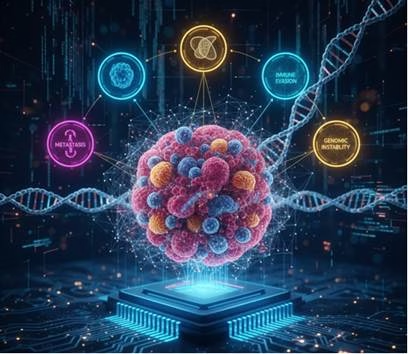
OncoMark shifts the focus from what the cancer looks like to what the cancer is doing. It leverages the concept of “Hallmarks of Cancer”—a set of ten underlying biological capabilities that turn normal cells into malignant ones, such as evading the immune system, resisting cell death, and sustaining infinite growth.
“In order so that we call a cell ‘cancerous’, what are the signs of it? For example, a cancer cell is going to look at its internal genetic signature and it’s going to ‘mess around with its death timer’,” explained Dr. Debayan Gupta, a lead researcher on the study from Ashoka University. “So, while a normal cell grows old and eventually dies, a cancer cell will turn off the death timer and say ‘I’ll just keep existing’.”
By quantifying these invisible processes, OncoMark essentially “reads the mind of cancer,” predicting whether a specific tumor is primed to metastasize or resist treatment long before physical symptoms escalate.
The Science: 3.1 Million Cells, Near-Perfect Accuracy
The development of OncoMark, detailed in a recent study published in the prestigious journal Communications Biology (part of the Nature Publishing Group), involved training an AI model on a massive dataset of 3.1 million individual cancer cells spanning 14 different cancer types.
The researchers, including Dr. Shubhasis Haldar of the S.N. Bose National Centre, utilized synthetic “pseudo-biopsies” to model the complex interactions between different cancer hallmarks. This innovative approach allowed the AI to learn patterns that are often missed in standard bulk tissue analysis.
The results have been statistically robust:
-
Internal Accuracy: The model achieved over 99% accuracy during internal testing.
-
External Validation: When tested against five independent datasets and 20,000 real-world patient samples, OncoMark maintained an accuracy rate exceeding 96%.
-
Versatility: The tool proved effective across diverse cancer types, identifying aggressive traits in tumors that appeared benign under traditional staging.
Expert Perspectives: The Shift to Precision
While OncoMark is a specific tool, it represents a broader shift in oncology toward AI-driven precision medicine. Independent experts emphasize that such tools are becoming essential for navigating the complexity of cancer biology.
“We are absolutely convinced that AI will be responsible for an irreversible transition in oncology,” notes Prof. Olivier Michielin, a specialist in precision oncology not involved in this specific study, speaking on the general rise of AI diagnostics. “Faced with an explosion in the complexity of genomic and clinical data, AI is rapidly becoming an indispensable tool… enabling us to detect molecular changes that can inform decisions about precision treatment.”
Similarly, Dr. Jasmin Hundal, a computational biologist and expert in cancer genomics, highlights the supportive role of these technologies: “AI does not replace the oncologist; rather, it acts as an amplifier. It provides the evidence-backed recommendations that allow humans to make complex decisions with greater confidence.”
Implications for Patients and Public Health
The potential clinical applications of OncoMark are vast. By providing a detailed “hallmark profile” for each patient, the tool could enable:
-
Tailored Therapies: Doctors could prescribe drugs that specifically target the most active hallmarks in a patient’s tumor (e.g., using immunotherapy for a tumor showing high “immune evasion” signals).
-
Early Intervention: Aggressive cancers often show high hallmark activity before they grow large. OncoMark could flag these high-risk cases early, prompting more aggressive treatment for tumors that might otherwise be dismissed as “early-stage.”
-
Cost-Effective Diagnostics: As a software framework that analyzes gene expression data, OncoMark could potentially be integrated into existing genomic testing workflows without the need for expensive new hardware.
Limitations and Future Outlook
Despite its promise, OncoMark is currently a research-grade tool. Transitioning from a computational framework to a certified clinical device requires rigorous prospective clinical trials to ensure safety and real-world reliability.
The researchers also acknowledge the need to expand the model’s capabilities. The current version focuses on solid tumors; future iterations aim to address blood cancers (leukemias) and rare cancer types, which possess distinct biological characteristics.
“We are looking to get the model integrated into clinical workflows so that doctors can use it for patients,” said Dr. Gupta, signaling the team’s commitment to translating this laboratory success into bedside care.
As cancer care moves away from a “one-size-fits-all” approach, tools like OncoMark offer a glimpse into a future where treatment is as unique as the patient’s own biology.
Medical Disclaimer
Medical Disclaimer: This article is for informational purposes only and should not be considered medical advice. Always consult with qualified healthcare professionals before making any health-related decisions or changes to your treatment plan. The information presented here is based on current research and expert opinions, which may evolve as new evidence emerges.
References
-
Primary Study: Haldar, S., Gupta, D., et al. (2025). OncoMark: A neural multi-task learning framework for comprehensive cancer hallmark quantification. Communications Biology. (Nature Publishing Group).
-
Expert Commentary: Quotes and context regarding AI in oncology adapted from public statements by Prof. Olivier Michielin (ESMO) and Dr. Jasmin Hundal (SABCS/OncData) regarding the general field of AI precision oncology.