 0
0
 0
0
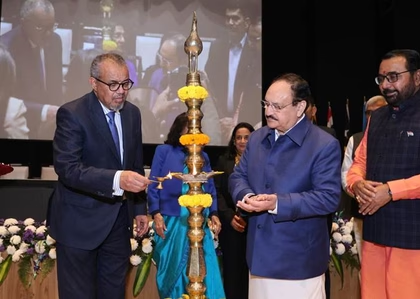
NEW DELHI — In a move that signals a robust commitment to the future of public health in South-East Asia, the World Health Organization (WHO) South-East Asia Regional Office (SEARO) has officially unveiled its newly redeveloped headquarters in New Delhi. The state-of-the-art facility was inaugurated this week by India’s Union Minister of Health and Family Welfare, Jagat Prakash Nadda, marking a significant milestone in the region’s ability to respond to emerging health threats and coordinate international aid.
The redevelopment of the SEARO building is more than a structural upgrade; it represents a “collective commitment to global health,” according to Minister Nadda. As the region continues to grapple with the dual burden of infectious diseases and a rising tide of non-communicable conditions, this new hub is designed to serve as the “nerve center” for eleven member countries, home to over a quarter of the world’s population.
A Modern Fortress for Public Health
The original SEARO building, a landmark in New Delhi’s Indraprastha Estate since the 1960s, had long outgrown its capacity to handle the complexities of 21st-century healthcare logistics. The new facility features advanced technological infrastructure, including dedicated emergency operations centers and enhanced digital connectivity aimed at streamlining real-time data sharing across borders.
“This building is not just about bricks and mortar,” Minister Nadda stated during the ceremony. “It is a symbol of our shared vision. It provides a platform where member nations can come together to tackle challenges like antimicrobial resistance, climate change-related health issues, and pandemic preparedness.”
The South-East Asia region is uniquely positioned in the global health landscape. It has been the site of significant victories—such as the eradication of polio and the elimination of maternal and neonatal tetanus—but it remains a hotspot for emerging zoonotic diseases and carries a disproportionate share of the global tuberculosis burden.
Strengthening Regional Sovereignty in Health
For healthcare professionals, the opening of this office signifies a shift toward more localized, regional decision-making. Historically, global health priorities have often been driven by Western institutions. The revitalization of SEARO suggests a move toward “South-South cooperation,” where nations with similar socioeconomic profiles share resources and strategies.
Dr. Aris Mazumdar, a global health policy analyst not involved in the SEARO project, notes the importance of this infrastructure. “Infrastructure dictates function. When you have a regional office equipped with modern epidemiological tools and high-level conferencing capabilities, you reduce the lag time between an outbreak discovery and a coordinated response. For the clinician on the ground in Dhaka or Jakarta, this means faster guidelines and more efficient supply chains.”
The renovation also emphasizes sustainability, incorporating green building standards that reflect the WHO’s broader mission to address the health impacts of climate change—a critical issue for a region frequently impacted by extreme weather events.
Statistical Context: The Weight of the Region
The significance of the SEARO office is underscored by the sheer scale of the population it serves. According to WHO data:
-
Population: The region accounts for approximately 26% of the global population.
-
Disease Burden: It carries nearly 30% of the global burden of tuberculosis and a significant portion of the world’s neglected tropical diseases.
-
Economic Impact: Non-communicable diseases (NCDs) such as diabetes and heart disease are now responsible for nearly 64% of all deaths in the region, necessitating a massive shift in healthcare infrastructure from acute care to chronic disease management.
By centralizing expertise in New Delhi, the WHO aims to provide member states—including Bangladesh, Bhutan, North Korea, India, Indonesia, Maldives, Myanmar, Nepal, Sri Lanka, Thailand, and Timor-Leste—with the technical support needed to reform national health systems.
Addressing the Challenges Ahead
While the new building is a cause for celebration, public health experts warn that physical infrastructure is only part of the solution. Critics and observers point out that the region faces significant hurdles that a new building alone cannot solve.
“The challenge remains the disparity in healthcare spending across the member nations,” says Sarah Jenkins, a researcher in international health systems. “While India is making strides in digital health, other nations in the SEARO block still struggle with basic primary care access. The success of this new headquarters will be measured not by its architecture, but by how effectively it can bridge the gap between the wealthiest and most vulnerable populations in the region.”
Furthermore, the region’s heavy reliance on external funding for programs like HIV/AIDS and malaria remains a point of concern. Experts suggest that the “collective commitment” mentioned by Minister Nadda must manifest as increased domestic health financing from all member states to ensure the long-term sustainability of the programs managed by SEARO.
What This Means for the Public
For the average citizen in South-East Asia, the redeveloped SEARO building translates to a more resilient safety net. It means that when the next health crisis arrives—be it a new virus or a climate-related disaster—there is a localized, high-tech command center ready to coordinate the delivery of vaccines, medicine, and expert guidance.
It also signals a push toward Universal Health Coverage (UHC). The WHO SEARO has been a vocal advocate for reducing out-of-pocket medical expenses, which currently push millions of families in the region into poverty every year. A modernized regional office provides the administrative “muscle” to help governments draft and implement insurance and subsidy programs.
Conclusion: A Beacon of Cooperation
The inauguration of the New Delhi facility serves as a reminder that health is a global endeavor. In an era where nationalism often threatens international cooperation, the joint effort between the Government of India and the WHO to rebuild SEARO stands as a testament to the belief that no nation can be healthy in isolation.
As the doors open to this new facility, the focus now shifts from construction to action. The world will be watching to see how this modernized hub leverages its new tools to improve the lives of the two billion people under its care.
Medical Disclaimer: This article is for informational purposes only and should not be considered medical advice. Always consult with qualified healthcare professionals before making any health-related decisions or changes to your treatment plan. The information presented here is based on current research and expert opinions, which may evolve as new evidence emerges.
Reference Section
Primary Source:
-
Lokmat Times. (2024, December). New WHO SEARO building shows collective commitment to global health: Nadda. https://www.lokmattimes.com/technology/new-who-searo-building-shows-collective-commitment-to-global-health-nadda-1/