 0
0
 0
0
CHANDIGARH — In a significant victory for public health initiatives and gender equity, Haryana has recorded a Sex Ratio at Birth (SRB) of 923 females per 1,000 males in 2025. This 13-point surge from the previous year marks the state’s highest performance in half a decade, signaling a potential turning point for a region historically challenged by deep-seated gender imbalances.
The latest data, released by state health officials on Friday, reveals that out of 5,19,691 births registered in 2025, 2,49,410 were female. This is a notable increase from 2024, where only 2,46,048 females were recorded among 5,16,402 births. Public health experts and government officials attribute this progress to a rigorous, multi-pronged crackdown on illegal prenatal sex determination and the unregulated sale of Medical Termination of Pregnancy (MTP) kits.
Decoding the Data: A Decade of Change
To understand the weight of this achievement, one must look at the historical trajectory of the state. In 2014, Haryana struggled with a dismal SRB of 871, placing it among the lowest in India. The subsequent decade has been a volatile but upward climb.
While the state reached a peak of 923 in 2019, the numbers fluctuated during the early 2020s, dipping to 914 in 2021 before stagnating around 916–917. The jump to 923 in 2025 matches the previous record, suggesting that the “plateau” in gender statistics may finally be breaking.
District-Level Triumphs and Trials
The statewide average masks a diverse landscape of local successes:
-
Panchkula: The standout performer, recording an SRB of 971—a massive 56-point leap from 2024.
-
Top Tier: Fatehabad (961) and Panipat (951) also crossed the 950 mark, approaching natural biological norms.
-
Laggards: Despite the overall rise, industrial hubs like Gurugram (901) and Sonipat (894) continue to underperform, with Sonipat actually seeing a seven-point decline.
The Enforcement Engine: Beyond the Numbers
Officials credit the 2025 surge to intensified enforcement of the Pre-Conception and Pre-Natal Diagnostic Techniques (PC-PNDT) Act. This involves “decoy operations” where undercover agents catch clinics offering illegal sex-selection services.
“The improvement is not accidental,” says a senior state health administrator. “It is the result of systematic monitoring of ultrasound clinics and a zero-tolerance policy toward the illegal sale of MTP kits, which were often used for gender-biased abortions outside of clinical oversight.”
The Role of Community Health
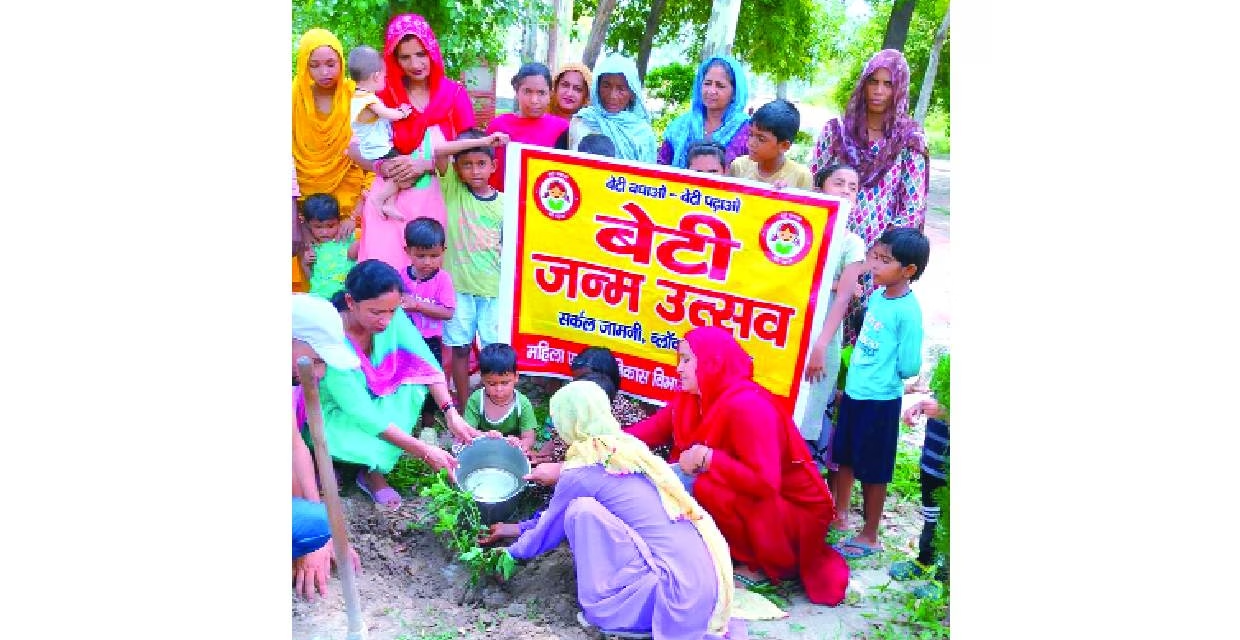
Public health researchers note that while law enforcement is crucial, the “Beti Bachao, Beti Padhao” (Save the Daughter, Educate the Daughter) campaign has shifted the cultural needle.
“When we see these numbers, we are seeing the convergence of policy and social change,” explains Dr. Ananya Sharma, a public health sociologist (independent of the report). “However, the dip in urban areas like Sonipat suggests that ‘son preference’ can persist even in affluent, educated pockets. It reminds us that surveillance must be as sophisticated as the technology used to circumvent it.”
Public Health Implications
A balanced sex ratio is more than just a statistic; it is a vital sign of a healthy society. A skewed ratio leads to a “marriage squeeze,” increased violence against women, and long-term demographic instability.
Why the SRB Matters for Healthcare:
-
Maternal Health: Crackdowns on illegal abortions reduce the number of “back-alley” procedures, which carry high risks of sepsis, hemorrhage, and maternal mortality.
-
Pediatric Care: States with higher SRB often show improved nutritional and immunization outcomes for girl children, as the “value” of the female child rises in the family unit.
-
Resource Allocation: Data from high-performing districts like Panchkula allows the Health Department to study which community-outreach models are working and replicate them in struggling districts like Sonipat.
Challenges and Counterarguments
Despite the celebration, some experts urge caution. Skeptics often point to the “registration gap”—the possibility that not all births, particularly those in remote areas, are captured in the Civil Registration System (CRS).
Furthermore, the decline in districts like Sonipat and the marginal growth in Gurugram highlight a “moving target” problem. As enforcement tightens in one district, families may travel to neighboring states or use portable, unregistered ultrasound machines that are harder to track.
“The goal should not just be 923,” says Dr. Rajesh Kumar, a former community medicine professor. “The biological natural sex ratio at birth is generally around 950. While 923 is a victory compared to 871, it still indicates that approximately 27 girls are ‘missing’ for every 1,000 boys born. We have closed the gap, but we haven’t healed the wound.”
What This Means for Residents
For the people of Haryana, these figures represent a changing social fabric. Increased SRB typically correlates with better educational opportunities for girls and safer environments for women.
For health-conscious consumers, the message is clear:
-
Seek Legal Care: Always use registered diagnostic centers for prenatal care.
-
Report Malpractice: Public participation in reporting illegal sex-determination clinics is often the catalyst for successful decoy operations.
-
Focus on Wellness: The shift in focus from “gender selection” to “neonatal health” ensures that all infants, regardless of sex, receive the critical care required in the first 28 days of life.
As Chief Minister Nayab Singh Saini noted, the journey from 871 to 923 has been a decade in the making. The challenge now lies in sustaining this momentum and ensuring that the “missing girls” of Haryana become a relic of the past.
Reference Section
- https://dailypioneer.com/news/haryanas-sex-ratio-rises-to-923-highest-in-five-years
Medical Disclaimer: This article is for informational purposes only and should not be considered medical advice. Always consult with qualified healthcare professionals before making any health-related decisions or changes to your treatment plan. The information presented here is based on current research and expert opinions, which may evolve as new evidence emerges.